
Live betting odds on Supreme Court rulings, vacancy probability, and the next nominee from Polymarket and Kalshi. Plus 2025-26 term overview, the nine justices, and major pending cases.
The 2025-26 Supreme Court Term
The Supreme Court's 2025-26 term began on October 6, 2025, and is scheduled to conclude by early July 2026. The justices accepted 58 cases for full briefing and oral argument this term, with the final arguments wrapping in late April 2026. As of late May 2026, 35 cases remain undecided, with rulings expected to be released throughout June.
This term is dominated by direct confrontations with the executive branch. The Court is set to rule on three landmark Trump administration policies in the coming weeks: the President's authority to impose sweeping global tariffs under the International Emergency Economic Powers Act, his executive order ending birthright citizenship for children of undocumented immigrants, and his attempt to fire FTC Commissioner Rebecca Slaughter without cause. Each ruling will reshape the boundary between presidential and congressional power for decades.
Beyond the executive-power cases, the term also features two cases on state laws barring transgender athletes from women's sports, a First Amendment challenge to a state ban on conversion therapy for minors, and the already-decided Louisiana v. Callais case, which in April 2026 effectively gutted Section 2 of the Voting Rights Act and triggered the current wave of mid-decade congressional redistricting across the South.
Major Pending Cases for the 2025-26 Term
These are the cases with the highest stakes for the rest of the term, ordered by significance. Most will be decided by the end of June 2026. Each card lists the case, the question presented, the current procedural status, and the date of oral arguments.
Learning Resources v. Trump
Awaiting Ruling
Whether the International Emergency Economic Powers Act of 1977 authorizes the President to impose sweeping global tariffs. Lower courts ruled the tariffs unlawful but allowed them to remain in effect pending appeal. At November 5, 2025 oral arguments, several conservative justices appeared skeptical of the administration's expansive reading of the statute.
Trump v. Barbara
Awaiting Ruling
Whether the executive order ending birthright citizenship for children of undocumented immigrants and visa holders is consistent with the Fourteenth Amendment's Citizenship Clause. Oral arguments on April 1, 2026 revealed widespread skepticism toward the administration's position, with multiple justices questioning whether the order can be squared with longstanding precedent.
Trump v. Slaughter
Awaiting Ruling
Whether the President can fire commissioners of independent regulatory agencies (the FTC, FCC, SEC, and others) without cause. The case stems from Trump's dismissal of FTC Commissioner Rebecca Slaughter. The Court's conservative majority signaled at December 8, 2025 arguments that they will likely overturn longstanding precedent protecting independent-commission members from at-will firing.
Trump v. Cook
Awaiting Ruling
Whether the President can fire a sitting member of the Federal Reserve Board of Governors. The Court allowed lower-court rulings blocking the firing of Governor Lisa Cook to stand pending the case. Justice Kavanaugh suggested at January 21, 2026 oral arguments that the Court may carve out a narrow exception preserving Fed independence even if it strikes down general for-cause protections in Slaughter.
West Virginia v. B.P.J.
Awaiting Ruling
Whether state laws barring transgender girls and women from participating in girls' and women's school sports violate Title IX or the Equal Protection Clause. The case, consolidated with a similar Idaho dispute, was argued in January 2026 and could affect dozens of similar laws in other states. The Court appeared open to allowing the bans at oral argument.
Chiles v. Salazar
Awaiting Ruling
Whether a Colorado law banning counselors from performing gender-identity conversion therapy on minors violates the First Amendment's free-speech protections. The case is one of several this term that test how far First Amendment doctrine extends into licensed professional speech. A ruling against Colorado would invalidate similar bans in roughly 20 other states.
Sports-event prediction markets
Cert. Pending
Whether the Commodity Futures Trading Commission's regulatory authority over event contracts pre-empts state gambling laws that would prohibit Kalshi and similar exchanges from listing sports markets. A Polymarket contract assigns roughly 87% probability that SCOTUS will accept the case before July 31, 2026. The outcome will determine whether prediction markets can list NFL, NBA, and MLB game outcomes nationwide.
Alabama redistricting emergency appeal
Appeal Pending
Whether Alabama can use a Republican-drawn congressional map for the 2026 midterms that a federal three-judge panel ruled "intentionally discriminated based on race." The panel issued a preliminary injunction on May 26, 2026, requiring the state to continue using the court-ordered 2024 map. Alabama Attorney General Steve Marshall said the state would "immediately appeal" to the Supreme Court. The case is the first major test of how broadly Louisiana v. Callais will reach. Two of the three panel judges who ruled against the state were Trump appointees.
Louisiana v. Callais
Decided
The most consequential election-law decision of the term, handed down April 29, 2026 by a 6-3 vote. The Court held that creating a second majority-Black district to comply with Section 2 of the Voting Rights Act was itself an unconstitutional racial gerrymander, raising the threshold for Section 2 claims to require proof of intentional discrimination. The ruling triggered the current wave of mid-decade redistricting across the South, with Tennessee, Florida, and Louisiana finalizing new maps and Alabama and South Carolina making unsuccessful attempts. Alabama tried but was blocked by a federal court on May 26, 2026 and now awaits the Supreme Court on emergency appeal. South Carolina's Senate rejected its own redistricting plan the same day.
Live SCOTUS Prediction Market Odds
Active prediction-market contracts tied to Supreme Court rulings, vacancies, and nominations, pulled live from Polymarket and Kalshi. Odds reflect the implied probability the crowd is assigning to each outcome. Cards refresh roughly twice daily as new market data arrives.
Current Court Composition: 6-3 Conservative Majority
The Supreme Court's current ideological breakdown is six conservatives appointed by Republican presidents and three liberals appointed by Democratic presidents. The conservative bloc includes Chief Justice John Roberts (often the median vote on close cases) and the more reliable conservative wing of Clarence Thomas, Samuel Alito, Neil Gorsuch, Brett Kavanaugh, and Amy Coney Barrett. The liberal bloc consists of Sonia Sotomayor, Elena Kagan, and Ketanji Brown Jackson.
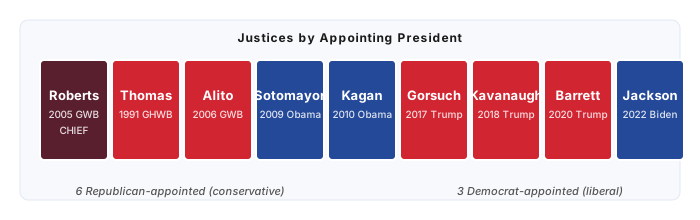
The current 6-3 split has held since the death of Justice Ruth Bader Ginsburg in September 2020, when Senate Majority Leader Mitch McConnell pushed through the confirmation of Amy Coney Barrett eight days before the November 2020 election. That confirmation cemented a durable conservative majority that has overturned Roe v. Wade, weakened the administrative state's regulatory authority, and most recently gutted Section 2 of the Voting Rights Act in Louisiana v. Callais.
Conservatives also do not always vote as a bloc, particularly on procedural questions and emergency-docket cases. Chief Justice Roberts is the most institutionalist of the conservative six and has occasionally joined the liberals to block executive overreach. Justice Barrett has shown an independent streak on questions of administrative law and free speech. The remaining four - Thomas, Alito, Gorsuch, and Kavanaugh - vote together on ideological cases more than 90% of the time.
The Nine Justices: Profiles and Backgrounds
Lifetime appointments mean the composition of the Court changes slowly. Eight of the nine sitting justices have been on the bench for at least four years; Justice Jackson, confirmed in 2022, is the most recent appointee. The oldest sitting justice is Clarence Thomas, who turned 77 in 2025 and has served since 1991 - making him both the oldest and longest-serving member of the current Court.
Chief Justice
Conservative
Conservative
Liberal
Liberal
Conservative
Conservative
Conservative
Liberal
Recent Major Rulings: The 2024-25 and 2025-26 Terms
The current Court has issued a string of consequential rulings reshaping American law on race, executive power, the administrative state, and election procedure. Here are the most significant decisions of the past 18 months, with vote counts and brief context.
6-3
Louisiana v. Callais
Holding that creating a second majority-Black congressional district to comply with Section 2 of the Voting Rights Act was itself an unconstitutional racial gerrymander. The ruling raised the threshold for Section 2 claims to require proof of intentional discrimination. Triggered the wave of mid-decade redistricting now reshaping the 2026 House map and an emergency Supreme Court appeal by Alabama after a federal panel blocked the state's GOP map on May 26, 2026. Alito majority, Kagan dissent.
7-2
Supreme Court denies Democratic bid to revive Virginia gerrymander
Denied a stay sought by Virginia Democrats trying to reinstate a Democratic-leaning congressional map that had been struck down by the Virginia Supreme Court in May 2025. The federal high court declined to interfere with the state court's interpretation of the state constitution, effectively ending Democratic redistricting efforts in Virginia for 2026.
5-4
Texas redistricting emergency order
Through an order written by Justice Alito, the Court reinstated Texas's new congressional map after a three-judge district court had blocked it. Alito wrote that partisan advantage was the state's "pure and simple" motive, which is permissible under existing doctrine. The three liberal justices dissented; Roberts joined the conservatives. Final ruling clearing the map permanently came April 27, 2026.
6-3
Trump v. CASA: Nationwide injunctions limited
Sharply restricted federal district courts' authority to issue nationwide injunctions against executive-branch policies. The ruling does not apply to the birthright citizenship order itself, which is now being litigated on its merits in Trump v. Barbara, but it removed one of the most powerful tools lower courts had used to block Trump administration policies during the first six months of the second term.
7-2
VanDerStok v. Garland: Ghost guns regulation upheld
Upheld the Bureau of Alcohol, Tobacco, Firearms and Explosives regulation of unfinished firearm components ("ghost guns") that can be assembled into functional weapons without serial numbers. The 7-2 majority included Chief Justice Roberts and Justice Barrett; Thomas and Alito dissented. The first significant Second Amendment loss for gun-rights advocates under the current Court.
6-3
Loper Bright v. Raimondo: Chevron deference overturned
Overruled the 40-year-old Chevron doctrine that had required federal courts to defer to agency interpretations of ambiguous statutes. The Court held that judges must exercise independent judgment in interpreting statutes, fundamentally weakening the regulatory authority of executive-branch agencies like the EPA, SEC, and FDA. Together with West Virginia v. EPA (2022), this completed the Court's reshaping of the administrative state.
6-3
Trump v. United States: Presidential immunity
Held that former presidents have absolute immunity from criminal prosecution for official acts taken within the "core" constitutional powers of the presidency, and presumptive immunity for all other official acts. The ruling, authored by Chief Justice Roberts, effectively ended the federal January 6 prosecution of Donald Trump and reshaped the constitutional limits on presidential conduct.
How the Supreme Court Works
How many justices are on the Supreme Court?
Nine. The number is set by federal statute, not the Constitution itself, and Congress has changed the size of the Court six times in U.S. history (most recently in 1869). Proposals to expand the Court - "court packing" - have circulated in recent years but have not gained meaningful legislative traction.
How are Supreme Court justices appointed?
The President nominates a justice; the Senate then holds confirmation hearings through the Judiciary Committee and votes on whether to confirm. Confirmation requires a simple majority (51 votes, or 50 plus the Vice President's tiebreaker). The filibuster for Supreme Court nominations was eliminated by Senate Republicans in 2017 to confirm Justice Gorsuch.
How long do justices serve?
For life, or until they choose to retire or resign. Article III of the Constitution gives federal judges tenure "during good behavior," which has been interpreted as a lifetime appointment subject only to impeachment. No Supreme Court justice has ever been removed by impeachment. The average tenure of justices on the current Court is roughly 16 years.
What is a writ of certiorari?
The formal request that a party files to ask the Supreme Court to review a lower-court decision. The Court grants "cert" in roughly 1% of the 7,000-10,000 petitions filed each year. It takes four justices to agree to hear a case, a procedural rule known as the "Rule of Four." Cases generally have to involve federal law, a constitutional question, or a split among the lower federal appeals courts.
What is the difference between the majority opinion, concurrence, and dissent?
The majority opinion is the Court's official ruling and establishes binding precedent. A concurrence agrees with the outcome but offers different reasoning. A dissent disagrees with the outcome. When a justice writes a concurrence "in the judgment only," they agree with the result but reject the majority's reasoning entirely. The most important Court dissents have sometimes become law decades later as the Court's composition shifted.
What is the "emergency docket" or "shadow docket"?
Cases decided without full briefing or oral argument, usually on requests for emergency stays, injunctions, or other rapid-response orders. The shadow docket has expanded sharply since 2017 and now accounts for many of the Court's most consequential rulings, including the December 2025 Texas redistricting order. Critics argue the lack of explanation in shadow-docket rulings undermines the Court's transparency; defenders argue it is necessary for urgent matters that cannot wait for full briefing.
How predictable are Supreme Court rulings?
More predictable than they used to be, but still subject to surprise. Roughly 60-65% of cases each term are decided by 9-0 or 8-1 margins; these are the boring procedural cases that the media and prediction markets rarely cover. The closely watched ideological cases tend to split 6-3 or 5-4. Prediction markets have a mixed track record: they correctly forecast the Dobbs ruling overturning Roe v. Wade roughly 18 months before it happened, but missed the Bostock v. Clayton County ruling extending Title VII to gay and transgender workers.
When does the Supreme Court term begin and end?
The term begins on the first Monday in October each year. Oral arguments are held from October through April. Rulings are issued throughout the term but cluster heavily in the final weeks of June, when the Court races to clear its docket before the summer recess. Each term is named for the year it begins, so the 2025-26 term began October 6, 2025.
Why are prediction markets useful for tracking SCOTUS rulings?
Because lawyers, journalists, and political insiders trade on these markets with real money, the prices aggregate information faster than traditional polls or expert forecasts. Markets responded to oral arguments in the Trump tariffs case within minutes, dropping the implied probability of a Trump win by nearly 30 points based on the justices' tone. That is a level of real-time analytical aggregation that simply did not exist 15 years ago.
Can a sitting justice be impeached or removed?
Yes, by the same process as the President. The House of Representatives can impeach a justice by majority vote; the Senate then holds a trial requiring a two-thirds vote to convict. Only one justice in U.S. history has been impeached: Samuel Chase in 1804, who was acquitted by the Senate. No sitting justice has been removed. Calls for impeachment of current justices over ethics issues have circulated but never gained the votes needed in either chamber.
Methodology and Sources
Live prediction-market odds on this page come from Polymarket's Gamma API and Kalshi's public markets API. Markets are categorized as "Supreme Court" by the title-keyword classifier in our auto-discovery engine, which captures markets containing terms like "SCOTUS," "Supreme Court," or "Justice" combined with a sitting justice's name. State-level supreme court markets (Wisconsin, Michigan, etc.) are excluded from this page.
Editorial content - the pending case summaries, justice profiles, and recent rulings timeline - is maintained manually and updated by us periodically. Justice ages, terms, and appointment data are current as of May 2026.
For broader political coverage, see our homepage of election prediction markets, the 2026 redistricting tracker, our political polls tracker, and the red states vs blue states map.
Major source references for this page: SCOTUSblog, Bloomberg Law, the Brennan Center for Justice, Ballotpedia, the Federal Judicial Center, and the Supreme Court's own published opinions at supremecourt.gov.