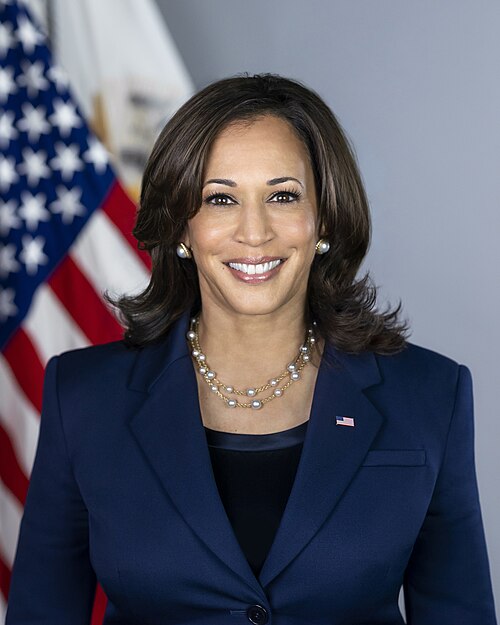
Kamala Harris

 Quick take
Former Vice President Kamala Harris has done more than any other 2024 nominee in recent memory to keep her political options open after losing, even if the election odds do not show it. She declined to run for California governor in July 2025, telling supporters that her leadership "will not be in elected office" for the time being but explicitly leaving the door open for a 2028 presidential run. Her September 2025 memoir 107 Days, an account of her abbreviated 2024 campaign, became a bestseller. The accompanying book tour ran through late 2025 and was extended into 2026 with stops in early-primary states including Mississippi, Alabama, Wisconsin and Michigan, the territory she lost narrowly to Trump. In interviews tied to the tour she has refused to rule out 2028, telling the BBC in October 2025 "I am not done" and CBS in early 2026 that another run was "possibly" on the table. Among Democratic primary voters she remains the most-tested name in the field.
 All Kamala Harris prediction markets
Every active prediction market that mentions Kamala Harris, pulled from Polymarket and Kalshi and updated twice daily. Probabilities reflect the midpoint of the bid-ask spread on each market.
 Path to the nomination
The base case
The base case for Harris is the simplest path of any Democrat in the field: name recognition, institutional support, and the political logic of a second chance. She is the only Democrat in the conversation who has actually been on a national ticket in this decade, which gives her a fundraising and field organization advantage that no other candidate can match from a standing start. Democratic primary polls released in spring 2026 have shown her at or near the top of the field. An Echelon Insights poll in May 2026 gave her 23 percent to Newsom's 17 and AOC's 11. Lake Research Partners showed her ahead in a ranked-choice scenario. Her path runs through Black voters, particularly Black women, the most reliable Democratic primary base. She held that base in 2020 and 2024 and has spent her post-vice presidency reinforcing those relationships. A run that consolidates the Black vote, the older Black women who served as her political family in the Senate, and the moderate Democratic establishment that prefers a known commodity becomes very hard for any single rival to break through.
The dark-horse scenario
The dark-horse scenario assumes Harris does not announce until late in the cycle and is propelled by a wave of anti-Trump sentiment after the 2026 midterms. The argument from her camp is that 2024 was a unique combination of late candidate substitution, abbreviated campaign timeline and an inflation environment that disadvantaged any incumbent-party candidate. None of those headwinds apply in 2028. If the Trump administration's second term goes badly enough by the time the primaries begin, the party may decide it wants someone who has already taken the fight to Trump rather than someone learning the rhythm of a national campaign for the first time. Harris would be that candidate. The risk is that the Democratic primary electorate decides the same logic that ended her career in 2024 still applies in 2028.
What could go wrong
What could derail her: a strong Newsom announcement that consolidates establishment donors. An AOC entry that pulls the energy and the youth vote. The lingering question of whether the 2024 result was about the campaign or about her personally as a candidate. Harris is the candidate the Trump administration most clearly wants in the race and has continued to attack publicly. A repeat of 2024's gendered and racial attacks is guaranteed if she runs, and the party's 2024 post-mortem is still being written. Her favorable numbers among Democrats have been stable since the loss but have not climbed.
 Background
Kamala Devi Harris was born in Oakland, California in October 1964, the daughter of a Jamaican economist and an Indian biomedical scientist who met in the civil rights movement at Berkeley. Her parents divorced when she was seven; she and her sister Maya were raised primarily by their mother. Harris graduated from Howard University, where she joined Alpha Kappa Alpha sorority and built the Black women's political network that has shaped her career. She earned her law degree from the University of California, Hastings in 1989 and joined the Alameda County District Attorney's office. She was elected San Francisco District Attorney in 2003 and California Attorney General in 2010, becoming the first Black woman in either job. She won her U.S. Senate seat in 2016. Her 2020 presidential campaign ended before the Iowa caucuses, but Joe Biden picked her as his running mate that summer, and she was sworn in as the 49th vice president in January 2021. She became the Democratic nominee in July 2024 after Biden withdrew, ran what she has herself described as the shortest competitive presidential campaign in modern American history, and lost to Trump 49.8 to 48.3 percent in the popular vote. She left office on January 20, 2025. She has been married since 2014 to entertainment attorney Doug Emhoff.
 Key positions
Harris's political identity has shifted across her career, from progressive prosecutor to centrist Democrat to the Biden administration's primary public voice on abortion, voting rights and immigration. As a senator she had one of the most liberal voting records in the chamber, but her 2024 general-election campaign moved toward the center on immigration, supporting a tougher border deal and increased enforcement. On abortion she has been one of the strongest Democratic voices since the 2022 Dobbs decision, framing the issue as central to her political identity. On healthcare she supported Medicare expansion but stopped short of Medicare for All in her 2024 platform. On crime she has navigated the awkward terrain of being a former prosecutor in a Democratic Party that moved left on criminal justice, defending her record without leaning into it. Her foreign policy positions have followed the Biden administration line on Israel, Ukraine and China. Where she ends up positioned in a 2028 campaign would depend on who else is in the field and where the Democratic primary electorate has moved by then.
 Catalysts to watch
The events most likely to move Kamala Harris's prediction-market odds in the months ahead.
- Whether and when she announces. Harris has refused to give a firm timeline. An announcement before the 2026 midterms would be unusual; after would be standard.
- The 2026 midterm results. A Democratic wave gives any 2028 candidate momentum; a wave that includes Harris-aligned candidates winning is the best version for her.
- Newsom's decision. A Newsom announcement would be the single biggest event for the Harris field calculation. The two come from the same California donor base.
- AOC's decision. A serious AOC campaign cuts into Harris's coalition from the left, particularly among younger Democrats.
- Whether her book tour translates into organizing. Harris has done significant retail politics in 2026 without calling it a campaign. The infrastructure she builds quietly matters more than the speeches.
- How the party processes the 2024 loss. The DNC post-mortem released earlier in 2026 was inconclusive. A more direct reckoning would shape Harris's standing.
 Other 2028 candidates
Continue exploring the field. Same-party candidates appear first; the full roster sits at our candidates index.