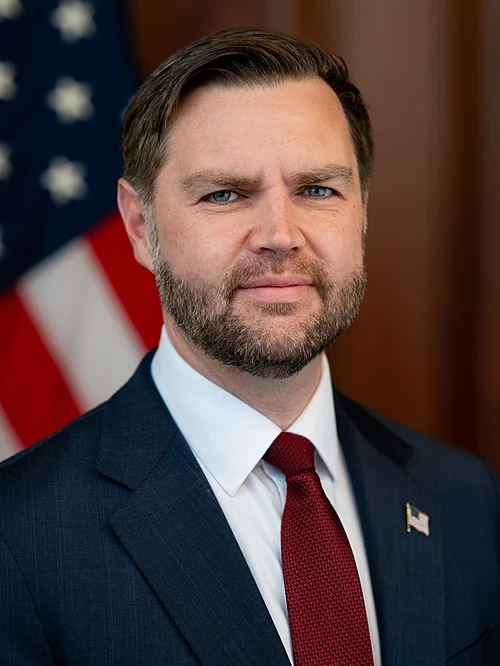
JD Vance

 Quick take
Vice President JD Vance is the clearest frontrunner in the 2028 Republican field, but his lead has been less stable in 2026 than the early election odds suggested. After taking office in January 2025 at age 40, Vance built early dominance on Polymarket through 2025, climbing as high as 51 percent at moments when Trump-aligned conservatives publicly anointed him the heir apparent. Through 2026, his price has bounced between the high teens and the mid-30s as Secretary of State Marco Rubio has gained ground and the GOP base has split over the Iran war. Vance led an unsuccessful round of peace negotiations with Iran in Islamabad in April 2026, an assignment that doubles as both a foreign-policy resume builder and a political risk. He has publicly put his own odds of running at "fifty-fifty," which is the closest any major Republican has come to acknowledging the race.
 All JD Vance prediction markets
Every active prediction market that mentions JD Vance, pulled from Polymarket and Kalshi and updated twice daily. Probabilities reflect the midpoint of the bid-ask spread on each market.
 Path to the nomination
The base case
The base case for a Vance nomination starts with the institutional weight of the vice presidency. No vice president who actively sought his party's nomination in the modern era has been denied it, and Vance has Trump's passive endorsement through proximity if not through public statement. His campaign infrastructure would inherit the entire Trump 2024 operation, including the digital fundraising lists, the field staff and the relationships with allied super PACs that funded Trump's general election. Tucker Carlson has publicly said Vance is the only person who can carry the Trump legacy. Erika Kirk of Turning Point USA endorsed Vance at the group's December 2025 summit. Outgoing Virginia Governor Glenn Youngkin endorsed Vance in January 2026 on his way out of Richmond. Each of those endorsements signals that the MAGA institutional architecture has already begun to consolidate around him.
The dark-horse scenario
The dark-horse path runs through the Iran war and through a fight over what comes next for the America First coalition. Vance built his political identity as a Marine veteran and a critic of American foreign entanglements, and his Senate years included high-profile votes against aid to Ukraine. The Trump administration's February 2026 strikes on Iran put him in an awkward spot: publicly loyal to a war he had reportedly opposed in private. If the Iran negotiations he led in April 2026 ultimately produce a lasting peace, Vance gets to claim the deal as both a foreign-policy achievement and a vindication of his anti-interventionist worldview. If the war drags on, restive anti-war conservatives could look elsewhere, with Carlson the most likely beneficiary on the populist right and Rubio on the institutional right. The risk for Vance is being squeezed in both directions at once.
What could go wrong
What could derail him: a Trump endorsement of someone else, most plausibly Rubio. Trump has publicly declined to name a 2028 favorite and has occasionally praised Rubio in terms that read as significant. A serious foreign-policy embarrassment beyond Iran. A challenge from the populist right, with Carlson openly speculating about a run as recently as May 2026 even as he has also said Vance is the only viable nominee. The vice presidency is structurally a strong position to run from but a fragile one to lead from this far out.
 Background
Vance was born James David Bowman in Middletown, Ohio in 1984. His childhood, marked by his mother's addiction and his father's absence, became the subject of his 2016 bestselling memoir Hillbilly Elegy. After graduating from Middletown High School in 2003, he enlisted in the United States Marine Corps and served in Iraq as a combat correspondent. He used the GI Bill to attend Ohio State University, graduating summa cum laude in 2009, then attended Yale Law School, earning his law degree in 2013. At Yale he met his wife, Usha Chilukuri Vance, a fellow law student who would later clerk for Chief Justice John Roberts. Vance worked briefly in corporate law before moving into venture capital with firms backed by billionaire Peter Thiel. He published Hillbilly Elegy in June 2016 to enormous critical and commercial success, briefly making him the most prominent conservative voice on the American white working class. Initially a sharp critic of Trump, calling him "America's Hitler" privately and "noxious" publicly, Vance reversed his position during his 2022 Senate campaign, secured Trump's endorsement, and won the Ohio Senate seat by 6 points. Trump picked him as his running mate in July 2024. He was sworn in as the 50th Vice President of the United States on January 20, 2025.
 Key positions
Vance has built his political identity around four pillars: economic nationalism, restricted immigration, social conservatism and a less interventionist foreign policy. On trade, he is an outspoken advocate for tariffs as a tool of industrial policy and has defended the Trump administration's 2025 and 2026 tariff regime more aggressively than most cabinet members. On immigration, he supports the mass-deportation framework and has publicly defended the administration's Minneapolis ICE operations. On social issues, he opposes abortion in most cases, opposes federal recognition of same-sex marriage, and has been an outspoken critic of what he calls cultural decline in American institutions. His foreign-policy record is the most complicated and the most politically consequential. As a senator, he led the opposition to Ukraine aid, arguing the war was not in America's interest. As vice president, he has publicly defended the Iran war while reportedly opposing it in internal administration debates. He is the leading voice in the administration for negotiation over escalation.
 Catalysts to watch
The events most likely to move JD Vance's prediction-market odds in the months ahead.
- Whether the Iran ceasefire holds. A lasting peace deal credited to Vance lifts his odds. A renewed war pulls them down.
- Trump endorsement signals. The president has so far stayed neutral. Any explicit signal toward Vance or Rubio would move markets immediately.
- 2026 midterms. A GOP wave gives Vance a tailwind. A blowout loss makes him the public face of a discredited administration.
- Tucker Carlson's decision on whether to run. Carlson at 7 percent on Polymarket is mostly polling on his platform, not his candidacy. An actual campaign would split the populist right.
- Rubio's trajectory. Rubio has climbed steadily through 2026. If he keeps climbing past 20 percent, the GOP race becomes a real two-way contest.
- Vance's own announcement. He has dodged direct questions about 2028 throughout his vice presidency. A formal launch, whenever it comes, will trigger a major repricing.
- Cabinet stability. A high-profile resignation or replacement could either help or hurt Vance depending on who leaves and why.
 Other 2028 candidates
Continue exploring the field. Same-party candidates appear first; the full roster sits at our candidates index.