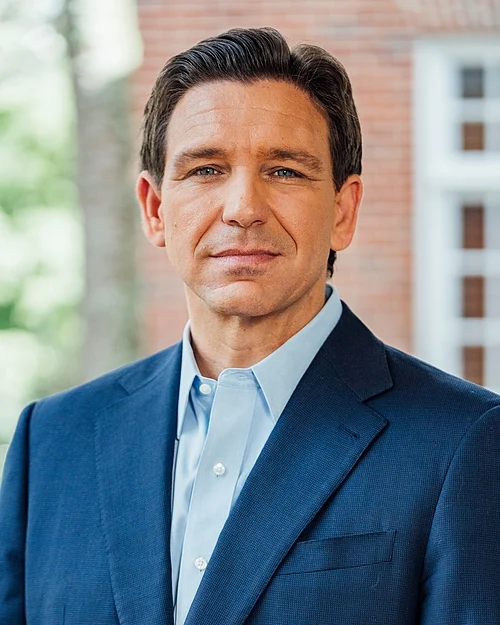
Ron DeSantis

 Quick take
Ron DeSantis enters the final year of his Florida governorship in a position that would have seemed implausible at any earlier point in his career: a former 2024 presidential candidate now running fourth or fifth in the US election odds, but with the political infrastructure and the timing to be ready for another shot. His Polymarket price has hovered between 2 and 5 percent through 2026, well below his peak of nearly 50 percent in 2022 and 2023 when many Republican donors viewed him as the obvious Trump alternative. DeSantis is term-limited out of Tallahassee on the first Tuesday after the first Monday of January 2027, meaning he will be a private citizen at the moment most 2028 Republicans need to start campaigning. He has spent 2026 keeping his name in the political conversation, including by calling a controversial April 2026 special legislative session on mid-decade congressional redistricting that drew national attention. His final State of the State on January 13, 2026 emphasized education and economic policy with little of the culture-war framing that defined his first term.
 All Ron DeSantis prediction markets
Every active prediction market that mentions Ron DeSantis, pulled from Polymarket and Kalshi and updated twice daily. Probabilities reflect the midpoint of the bid-ask spread on each market.
 Path to the nomination
The base case
The base case for DeSantis is the simplest version of an underdog argument: he has done this before, he has the donor relationships, and the timing of his term ending in early 2027 lines up almost perfectly with a 2028 campaign launch. The 2024 campaign that ended in Iowa damaged him politically but gave him a national fundraising apparatus that no other below-the-top-tier candidate has. Florida's 2026 special session on redistricting has positioned the state to gain three to five additional Republican House seats, which DeSantis can credibly claim as his accomplishment. If the 2026 midterms break against Republicans, conservatives looking for an alternative to the Trump coalition will look at the governor who built one of the most aggressive policy operations in the country during his time in Tallahassee. DeSantis's policy resume includes a near-total abortion ban, the parental rights in education law sometimes called the Don't Say Gay law, the anti-DEI laws aimed at Florida's state universities, and a series of high-profile fights with Disney that became national stories. That resume plays to a slice of the Republican primary electorate that does not currently see itself in either Vance or Rubio.
The dark-horse scenario
The dark-horse scenario assumes the Vance-Rubio top tier exhausts itself in a competitive primary and DeSantis emerges as a third option with established credentials. His Iowa-focused 2024 campaign showed he could organize the state's evangelical caucus electorate, the demographic that has historically picked Republican nominees. He left Iowa with the second-place finish even after Trump's landslide win, ahead of Nikki Haley and ahead of where prediction markets had priced him going in. The institutional Republican donor class that funded his 2024 campaign has not moved en masse to either Vance or Rubio. If the 2028 cycle takes its more typical shape, with multiple Republicans competing for delegates state by state, DeSantis is positioned to be the second-cycle candidate that GOP primaries occasionally reward.
What could go wrong
What could derail him: he is essentially running against the political reality that Trump endorsed against him in 2024 and the MAGA coalition has moved on. Vance has the youth and the populist energy. Rubio has the institutional momentum and the visibility. DeSantis has the resume and the political wounds, and prediction markets are pricing him accordingly. A weak finish in the 2026 special session, or a Florida political controversy that drags into his final months, would compound the problem.
 Background
Ronald Dion DeSantis was born in Jacksonville, Florida in September 1978. He attended Yale University on a baseball scholarship, captained the team his senior year, and graduated in 2001. He earned his law degree from Harvard in 2005. He was commissioned in the Navy JAG Corps and deployed to Iraq in 2007 as a legal adviser to a Navy SEAL commander, work that included reviewing detainee interrogation procedures at Guantanamo Bay. After his naval service, he prosecuted federal cases as a Special Assistant U.S. Attorney in the Middle District of Florida. He was elected to the U.S. House from Florida's 6th District in 2012, served three terms, and resigned to run for governor in 2018. He won the GOP primary with Trump's endorsement and the general election by 0.4 points over Andrew Gillum. He was re-elected in 2022 by 19 points, the largest gubernatorial victory in Florida in 40 years, in what was widely interpreted as a launching pad for 2024. His 2024 presidential campaign launched in May 2023 with high expectations, raised $150 million, finished second in the Iowa caucuses behind Trump, and ended before the New Hampshire primary. He returned to Tallahassee for the final two years of his governorship. He and his wife Casey DeSantis have three children.
 Key positions
DeSantis has built one of the most aggressive conservative state-policy operations in the modern era. On education, he pushed the parental rights law commonly called the Don't Say Gay law, the Stop WOKE Act limiting how race and gender are taught in schools and state universities, and a major overhaul of Florida's state university system that included replacing the New College board with appointees aligned with his agenda. On abortion he signed a six-week ban in 2023. On immigration he signed one of the country's toughest state-level enforcement bills, which included penalties for employers hiring undocumented workers. On COVID-19 policy he was an early national figure for his opposition to school closures, mask mandates and vaccine requirements. His ongoing fight with Disney over the parental rights law led to the dissolution of the Reedy Creek Improvement District and a multi-year legal battle. His 2026 special session pushed an aggressive mid-decade redistricting plan, which advocates argue could add three to five Republican House seats and which critics call partisan gerrymandering of the type Florida's constitution prohibits.
 Catalysts to watch
The events most likely to move Ron DeSantis's prediction-market odds in the months ahead.
- The end of his Florida term in January 2027 and what he does immediately after. A presidential exploratory move in the first quarter of 2027 would be a major event.
- The 2026 special session outcome and whether the new Florida congressional map survives legal challenge.
- 2026 midterm results in Florida. A strong GOP wave in the state plays as DeSantis's legacy. Democratic gains play as evidence that his model is fading.
- Whether the Vance-Rubio top tier consolidates or fragments. DeSantis benefits more from a messy GOP primary than a clean one.
- His final State of the State and the policy choices he makes in his lame-duck year. Big swings get attention. Quiet competence does not.
- Trump signaling. Trump endorsed against DeSantis in 2024 and has not signaled rehabilitation. Any thaw would be a major story.
 Other 2028 candidates
Continue exploring the field. Same-party candidates appear first; the full roster sits at our candidates index.