
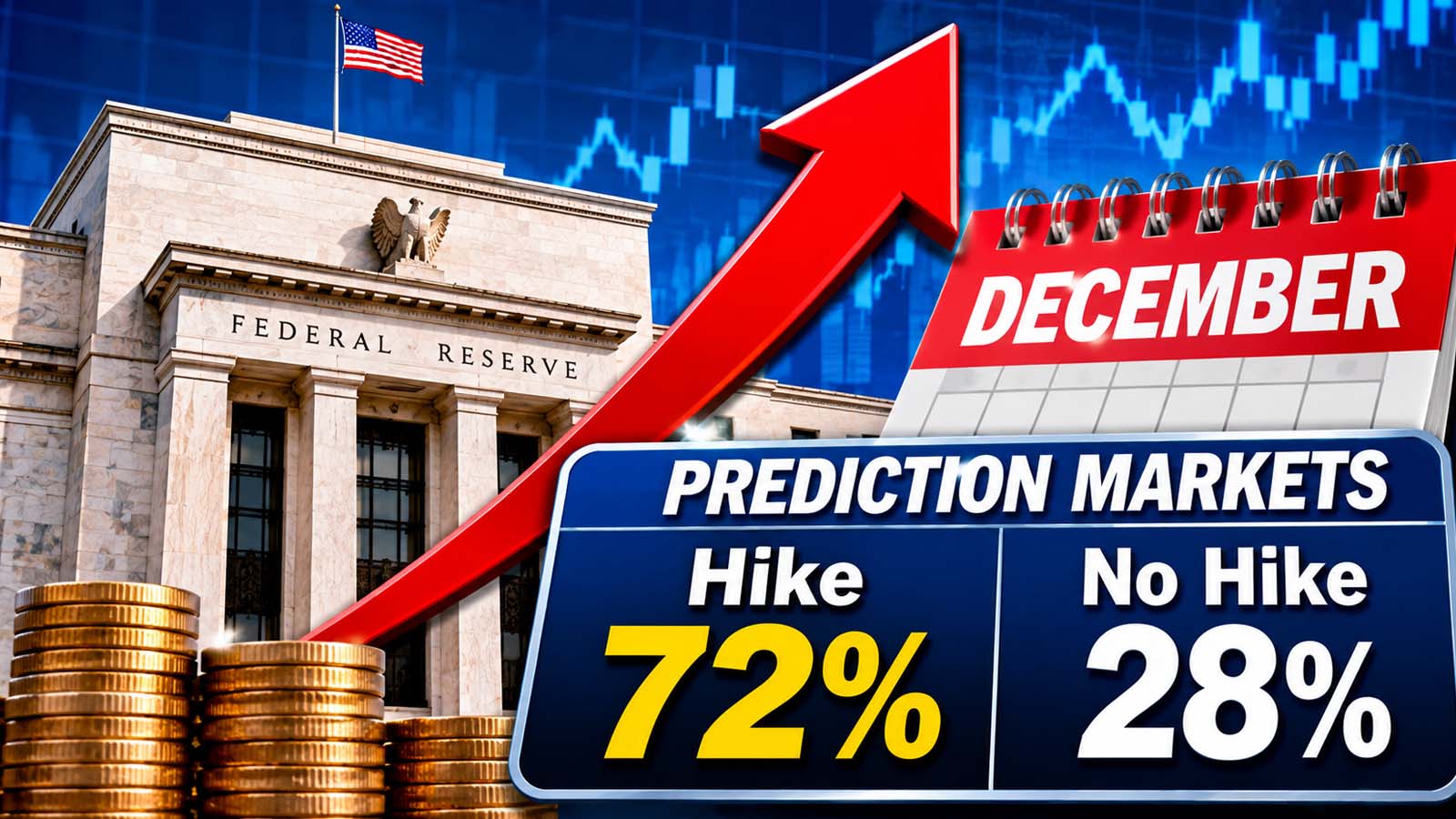
- Election-market traders put a quarter-point December hike at 77% and a hold at 23%, with every other outcome at 2% or less.
- Two of the 12 voters, Lisa Cook and Beth Hammack, wanted a quarter-point hike on Oct. 28, and the other 10 chose to hold.
- Sixteen of 18 Fed participants projected a higher year-end rate in September, but Chair Kevin Warsh said he does not prejudge meetings.
- October consumer price data is due Tuesday, and November’s arrives Dec. 10, a day after the Dec. 9 decision.
WASHINGTON – Election-market traders put December Fed rate hike odds at 77% for a quarter-point increase, against 23% for a hold, at about 5:35 a.m. ET on Nov. 9. The Federal Open Market Committee meets Dec. 8-9, and Fed Chair Kevin Warsh told reporters Oct. 28 that he does not believe in prejudging meetings.
The Hike Contract Has Closed Between 65% And 81% Since Sept. 26
Prediction-market exchanges list contracts on Fed meetings, and election odds traders use them to price each decision. The December hike contract pays if the Fed raises its target range by exactly 25 basis points on Dec. 9, and its midnight ET closes since Sept. 26 have ranged from 65% to 81%.
| Midnight ET Entering | Hike 25 Bps Odds |
|---|---|
| Sept. 27 | 69% |
| Oct. 15 | 79% |
| Oct. 28 | 74% |
| Oct. 29 | 78% |
| Oct. 30 | 70% |
| Nov. 5 | 81% |
| Nov. 6 | 65% |
| Nov. 7 | 77% |
| Pull at about 5:35 a.m. Nov. 9 | 77% |
Source: election-market contract for a 25-basis-point hike at the December 2026 Fed meeting. Rows show the daily close at midnight ET entering each date, plus the latest pull.
| Outcome | December Odds | January Odds |
|---|---|---|
| Hike 25 bps | 77% | 21% |
| Hold | 23% | 75% |
| Hike more than 25 bps | 2% | 2% |
| Cut 25 bps | 2% | 3% |
| Cut more than 25 bps | 1% | 1% |
Source: election-market contracts on each meeting’s decision, last trades at about 5:35 a.m. ET Nov. 9. Columns do not sum to 100% because last trades and bid-ask spreads differ.
The Oct. 28 decision moved the contract inside a 10-point range. It traded between 73% and 83% that day, closed at 78% and slid to 70% by the close of Oct. 29, so a contract bought at the 83% high was worth 70 cents a day later.
The January contract prices a hold at 75% and a quarter-point hike at 21%, so a December hike is priced 56 points above a January one.
The market is also far larger than it was before the decision. Open contracts on the December hike climbed from about 167,000 at the close of Oct. 27 to about 847,000 at the Nov. 9 pull, so the 77% rests on a much bigger book than the 74% close that preceded the decision.
The Contract Rose From 65% To 77% On Jobs Day
The contract fell from 76% to as low as 62% in the 10 a.m. ET hour on Nov. 5 and closed that day at 65%.
The contract went from 70% to 79% in the 8 a.m. hour on Nov. 6, on about 69,000 contracts, after the Bureau of Labor Statistics said at 8:30 a.m. ET that October payrolls grew by 165,000 and that unemployment held at 4.1%. It closed the day at 77%.
Revisions in the same release lifted August to 186,000 jobs from 133,000 and September to 60,000 from 29,000, so the two months now carry 84,000 more jobs than first reported.
Trading on Nov. 6 reached about 323,000 contracts, the most of any day since Sept. 26, after about 243,000 on Nov. 5. Volume fell to about 24,000 on Nov. 7 and 33,000 on Nov. 8, and the price stayed at 77%. The 62% low on Nov. 5 and the 80% high on Nov. 6 sit 18 points apart, the range a position carries into Tuesday’s report.
Warsh Said He Does Not Prejudge Meetings
Ten of the committee’s 12 voters chose on Oct. 28 to leave the target range at 3.75% to 4%, according to the Federal Reserve’s statement. Lisa Cook, a Fed governor, and Beth Hammack, who leads the Cleveland Fed, cast the two dissents, and each wanted a quarter-point increase. The statement said “Inflation remains elevated” and tied the next decision to “the accumulation of more information.”
At his press conference, New York Times reporter Colby Smith said most of Warsh’s colleagues seemed ready to raise rates in December and asked why not raise them that day. Warsh answered that “quashing inflation is not about some fixed individual date on a calendar” and that it is also not about “some isolated data point,” according to the Fed’s transcript.
Associated Press reporter Chris Rugaber then asked whether Warsh still saw widespread support for another hike this year. Warsh said he does not favor forward guidance in ordinary times and added, “I also don’t believe in prejudging meetings.” He said the committee could learn a lot before it meets again, and he pointed to colleagues who could speak publicly once the blackout period ended.
Dallas Fed President Lorie Logan, who voted to hold on Oct. 28, said in remarks to Davidson College students on Oct. 30 that the committee needs to implement “at least two more 25-basis-point rate increases.” She added that “skipping a meeting does not change the monetary policy destination,” and her remarks show that a hold vote in October did not mean opposition to higher rates.
Sixteen Of 18 Fed Participants Projected A Higher Year-End Rate
In the Fed’s September projections, 12 of 18 participants saw the federal funds rate ending 2026 at a 4.125% midpoint, four saw 4.375% and two saw 3.875%, the midpoint of the current range. With December the only meeting left in 2026, 16 of 18 participants, or 89%, expected a higher rate by year-end. The market’s 77% sits below that share.
Warsh said Oct. 28 that he does not submit a projection of his own, so the chair’s view is not among the 18. The projections also predate the October hold, in which 10 of the committee’s 12 voters chose not to raise rates, and a December hike would need a majority of those 12 voters, up from two in October.
Only One CPI Report Lands Before The Dec. 9 Decision
On the bureau’s calendar, October’s consumer price index arrives Tuesday, Nov. 10, at 8:30 a.m. ET, November’s employment report follows on Dec. 4, and November’s consumer price index comes Dec. 10, one day after the committee’s decision.
For September, the index climbed 0.6% from August and 3.7% from a year earlier, with gasoline up 9.1% and responsible, by the bureau’s account, for more than half of the month’s increase. Warsh said Oct. 28 that “energy and related prices have moved higher again in recent weeks.”
The 77% depends on the vote more than the data. It requires a majority of the 12 voters, 10 of whom chose to hold in October, to back a hike on Dec. 9, while the chair has said price stability is not about “some isolated data point.” The committee announces its decision Dec. 9, one day before the November consumer price report.
