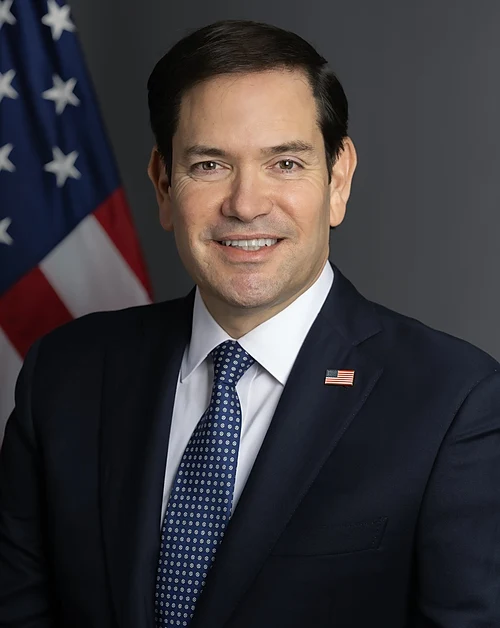
Marco Rubio

 Quick take
Marco Rubio has run one of the most remarkable political reinventions in modern American history, going from the senator Donald Trump labeled "Little Marco" in 2016 to the Trump cabinet member that the same president now calls his probable successor. Rubio's prediction-market price has more than tripled since he was sworn in as secretary of state in January 2025, climbing especially fast after the January 2026 Venezuela operation that captured Nicolas Maduro and the February 2026 strikes on Iran. He sits behind Vice President JD Vance on most US election markets but ahead of Vance on at least one major poll: an early-May 2026 AtlasIntel survey of Republican voters that gave Rubio 45.4 percent to Vance's 33.6. Trump has publicly praised Rubio in terms more lavish than he has used for Vance, including the claim that Rubio will go down as the best secretary of state in American history. A quiet "Draft Rubio" donor movement has emerged inside the broader Trump coalition.
 All Marco Rubio prediction markets
Every active prediction market that mentions Marco Rubio, pulled from Polymarket and Kalshi and updated twice daily. Probabilities reflect the midpoint of the bid-ask spread on each market.
 Path to the nomination
The base case
The Rubio path begins with the fact that Trump himself has been seen openly weighing the question of his own succession, and Rubio has been the most visible cabinet member in that calculation. Rubio holds three administration jobs simultaneously: secretary of state, acting national security adviser and acting administrator of USAID. He led the diplomatic response to Venezuela, gave the U.S. its public face during the Iran war and traveled with Vance to the Milan Cortina Winter Olympics opening ceremony in February 2026. His political base is Florida, the largest swing state of the last cycle, and his fluent Spanish gives him a hold on the Latino vote that no other Republican can match. Rubio's campaign infrastructure from his 2016 presidential run has been substantially rebuilt by the donors who funded his Senate races. He has the institutional support and the demographic position to be a credible second choice for anyone who started with Vance.
The dark-horse scenario
The dark-horse scenario for Rubio is direct: Vance falters and Trump publicly tilts toward Rubio. Trump has so far refused to name a favorite, but he has gone out of his way at multiple public events to draw attention to Rubio's performance, including a line at a March 2026 White House ceremony in which Trump joked he did not want Rubio "to get too popular" because then "all of a sudden you see, Where's Marco, he's not around anymore." The MAGA base reads those signals carefully. If Vance is seen as having mishandled Iran, or if Trump decides Vance has become his own brand rather than an extension of Trump's, Rubio is positioned to be the alternative the administration insiders rally around without breaking with Vance personally. The path is one of patient positioning: stay loyal, stay visible, do the foreign-policy work the president cares about, and wait for the political weather to shift.
What could go wrong
What could derail him: a public falling-out with Vance that the administration cannot manage. A foreign-policy reversal blamed on the State Department. A Trump endorsement of Vance that ends the conversation. Rubio also has to manage the optics of being seen as positioning openly, which he has so far avoided by deferring publicly to Vance whenever asked about 2028. The classical version of how this normally ends for a sitting secretary of state is that they get talked about, they wait their turn, and somebody else wins. Rubio is trying to be the exception.
 Background
Marco Antonio Rubio was born in Miami in May 1971, the son of Cuban immigrants who fled the island in 1956. His father worked as a bartender, his mother as a hotel maid and stock clerk, a working-class background that Rubio has made central to his political identity. He grew up between Miami and Las Vegas before settling in West Miami, graduated from South Miami Senior High School in 1989 and attended Tarkio College in Missouri on a football scholarship before transferring to Santa Fe Community College and then the University of Florida. He earned his law degree from the University of Miami in 1996. He served as a West Miami city commissioner from 1998 to 2000, then in the Florida House of Representatives from 2000 to 2008, where he rose to speaker of the House. He won his U.S. Senate seat in 2010 against the sitting Republican governor Charlie Crist and was re-elected in 2016 and 2022. His 2016 presidential campaign collapsed after Trump won Florida's GOP primary, an outcome Rubio has cited publicly as the moment he learned the most about American politics. He was Trump's nominee for secretary of state in November 2024 and was confirmed unanimously by the Senate in January 2025. He and his wife Jeanette Dousdebes Rubio, a former Miami Dolphins cheerleader, have four children.
 Key positions
Rubio has built his Trump-era political identity around hawkish foreign policy, hard-line immigration enforcement and conservative cultural positions. As secretary of state he has been the public architect of the administration's aggressive postures toward Iran, Venezuela, Cuba and China, all framed in moral terms about American leadership rather than purely transactional ones. He supported the February 2026 Iran strikes, defended them publicly, and led negotiations alongside Vance in Islamabad. He coordinated the Venezuela operation that captured Nicolas Maduro in January 2026, a personal political victory given his decade of work on Venezuela as a senator. On immigration, he has defended the administration's mass-deportation framework, though his prior career in the Senate included a brief stint working on bipartisan immigration reform in 2013. On social issues he holds traditional Catholic positions on abortion, marriage and religious liberty. His Senate voting record skewed more institutionally conservative than populist, but his cabinet record has been fully aligned with Trump's nationalist agenda.
 Catalysts to watch
The events most likely to move Marco Rubio's prediction-market odds in the months ahead.
- Trump endorsement signals. Trump has praised Rubio publicly in ways that could be read as preference. Any explicit signal would move markets sharply.
- Iran outcome. A lasting peace credited partly to Rubio strengthens him. A renewed war hurts him more than Vance because Rubio championed the strikes.
- Whether Vance falters. The Rubio path is essentially being the obvious second choice.
- Venezuela. Rubio owns the Maduro capture politically. The post-Maduro transition could become a major test.
- Florida politics. Rubio's Senate seat was filled by special election after his resignation. The eventual replacement and the 2026 special could affect his standing at home.
- Donor positioning. The Draft Rubio movement reported by ABC News in March 2026 is real but quiet. Any public organizational push would be a major event.
- CPAC and similar straw polls. Rubio took second at CPAC in March 2026, his strongest showing at that event in years.
 Other 2028 candidates
Continue exploring the field. Same-party candidates appear first; the full roster sits at our candidates index.