
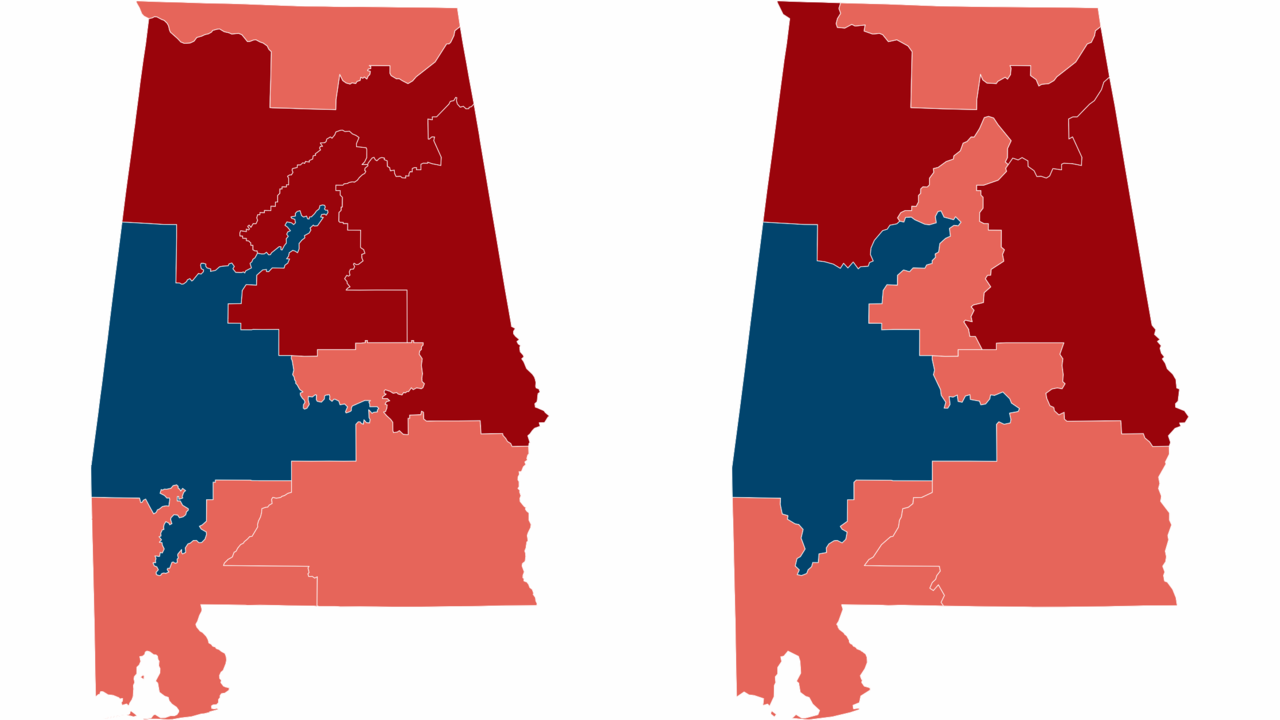
A federal court just took a Republican House seat off the board for the November midterms, and the Supreme Court is about to decide whether to put it back.
- A three-judge federal panel in Birmingham issued a preliminary injunction on May 26 blocking Alabama from using a Republican-drawn congressional map that would have eliminated one of the state's two Black-majority districts. The panel ruled the map "intentionally discriminated based on race."
- Two of the three judges who issued the ruling were Trump appointees. Alabama Attorney General Steve Marshall said the state would "immediately appeal" to the U.S. Supreme Court.
- The blocked map would have flipped Alabama's 2nd Congressional District, currently held by Democratic Rep. Shomari Figures, from a likely Democratic seat to a likely Republican one, a swing of roughly +1 GOP seat in the House.
- The same day, the South Carolina Senate rejected its own House-passed redistricting plan, ending the GOP push to redraw Rep. Jim Clyburn's 6th District before November.
- Polymarket currently gives Democrats an 81% chance of flipping the U.S. House in 2026. The Alabama and South Carolina decisions, combined, removed two of the projected Republican seat pickups from the mid-decade redistricting wave.
- The Alabama ruling sets up the first major test of how broadly the Supreme Court's April 29 Louisiana v. Callais decision will reach. That ruling significantly weakened Section 2 of the Voting Rights Act and triggered the current wave of Southern state map redraws.
BIRMINGHAM, Ala. -- The same federal court that struck down Alabama's congressional map in 2023 did it again Tuesday, this time stopping the state from using a new Republican-drawn map in November and setting up an emergency Supreme Court appeal that could decide control of the U.S. House.
The three-judge panel in U.S. District Court in Birmingham issued a preliminary injunction blocking Alabama from switching maps for the 2026 midterms. The ruling requires the state to continue using the same court-ordered districts under which representatives were elected in 2024.
"We cannot see our way clear to requiring Alabamians to cast their votes in the 2026 elections under a districting plan tainted by intentional race-based discrimination," the panel wrote.
Two of the three judges, Anna Manasco and Terry Moorer, were appointed by President Trump.
The decision is the first major federal court rejection of a Republican mid-decade redistricting map since the Supreme Court's April Callais ruling.
What Alabama Was Trying to Do
The blocked map traces back to a 2023 lawsuit. In Allen v. Milligan, the Supreme Court ruled that Alabama's existing congressional map violated Section 2 of the Voting Rights Act by packing Black voters into a single district. A lower court imposed a new map that created a second Black-majority district, AL-2, running from Mobile to Montgomery.
In November 2024, Democrat Shomari Figures won the new AL-2 by roughly 9 points over Republican Caroleene Dobson, taking 54.6% of the vote. Figures became the second Black House member from Alabama in modern history.
Then came Louisiana v. Callais. On April 29, 2026, the Supreme Court ruled 6-3 that the Voting Rights Act could not be used to require states to draw majority-minority districts when doing so amounted to racial gerrymandering. Justice Alito's opinion did not formally overturn Section 2, but Justice Kagan wrote in dissent that the ruling rendered Section 2 "all but a dead letter."
Alabama moved within a week. Governor Kay Ivey called a special session, and the legislature passed a law allowing the state to revert to the 2023 Republican-drawn map that had originally been struck down. The federal injunction blocking that map was lifted on May 11.
The injunction was reinstated 15 days later.
What Tuesday's Ruling Said
The same three-judge panel that ruled against Alabama in 2023 was directed by the Supreme Court to revisit the question in light of Callais. The panel revisited it. The answer did not change.
"Substantial evidence shows that Alabama intentionally discriminated based on race in violation of the Constitution," the panel wrote, distinguishing the Alabama case from the Louisiana situation. Where the Louisiana legislature had drawn its map to comply with what it understood as a Voting Rights Act mandate, the panel found, Alabama had specifically targeted the Black voting power that the 2023 court-ordered map had created.
The ruling requires Alabama to continue using the court-ordered 2024 map. That map gives Democrats a realistic shot at holding AL-2 in November.
State Sen. Barry Moore, a Republican candidate for the Alabama Senate seat being vacated by Tommy Tuberville, called the ruling "another example of unelected bureaucrats trying to override the will of Alabama voters."
Attorney General Marshall was more direct. "Know this: in my mind, it is not a matter of whether we win this case, only when," he said in a statement.
South Carolina Quietly Folds
The Alabama ruling was not the only redistricting news Tuesday. In Columbia, the South Carolina Senate rejected the House-passed redistricting bill that would have redrawn the 6th Congressional District held by Democrat Jim Clyburn, the longest-serving member of the state's House delegation.
Governor Henry McMaster had called the legislature back into special session after the regular session ended without a new map. The state House amended its redistricting legislation and passed it to the Senate on May 20. The Senate rejected it six days later.
The rejection by a Republican-controlled chamber effectively ended South Carolina's 2026 redistricting effort. The Clyburn seat will not be on the redrawn list. McMaster has not publicly ruled out another attempt, but the political path is now closed.
Two states. Two GOP map plans. Both stopped in the same day.
What It Costs Republicans on the Map
Before May 26, the projected GOP seat swing from completed and pending mid-decade redistricting sat at roughly +10 to +15 seats nationwide. The combined math: Texas +5, Florida +3 to +4, North Carolina +3, Ohio +2, Missouri +1, Tennessee +1, Louisiana +1, Alabama +1, South Carolina +1, offset by California's -5 Democratic response.
The Tuesday rulings remove the Alabama and South Carolina contributions for 2026. That brings the projected swing to roughly +9 to +14 seats. If the Supreme Court reverses Alabama on emergency appeal, Alabama goes back on the board and the number climbs to +10 to +15.
The full state-by-state breakdown sits on our 2026 redistricting tracker, updated daily.
What the Markets Say
Polymarket's most-watched 2026 market currently gives Democrats an 81% chance of winning the U.S. House. That price has held steady through most of May, despite the recent flurry of court rulings.
The Balance of Power market, which has traded more than $7.2 million in volume, currently prices a Democratic sweep of both chambers at 47.5%. A split Congress (Republicans hold Senate, Democrats flip House) sits at 32.5%. A Republican sweep is at 13.5%.
Alabama itself has 104 active prediction markets on Polymarket covering the 2026 midterms, with more than $10.1 million in combined trading volume. The Alabama 2nd District specifically has not seen a dramatic re-pricing since the Tuesday ruling, in part because the outcome was already partially priced in by traders who expected the map to be litigated.
The Supreme Court's eventual decision on Alabama's emergency appeal is now the single most important pending event in the mid-decade redistricting wave. If the Court reverses the panel, Republicans get their seat back. If the Court declines to intervene, Alabama's AL-2 stays Democratic-leaning and the GOP's path to holding the House narrows.
The Bigger Picture
Tuesday was the second federal court setback for the mid-decade redistricting effort in seven days. On May 19, the Supreme Court declined to expedite the timeline for Louisiana's pending appeal, leaving the state in active redraw mode.
Eight states have new congressional maps locked in for 2026: Texas, Florida, North Carolina, Ohio, Missouri, Tennessee, Utah, and California. Louisiana is finalizing its court-mandated redraw and is expected to pass a new map by early June. Alabama and South Carolina are now off the 2026 list, at least until the Supreme Court rules.
The combined projected GOP swing of +9 to +14 seats is still enormous in historical terms. The current House majority is 217-212. Republicans could absorb a typical midterm backlash if they hold every redistricting gain.
They are not currently on track to do so.
Live odds on the House, the Senate, every 2026 statewide race and the redistricting markets sit on ElectionOdds.com.
The 2026 midterm elections are November 3, 2026.