
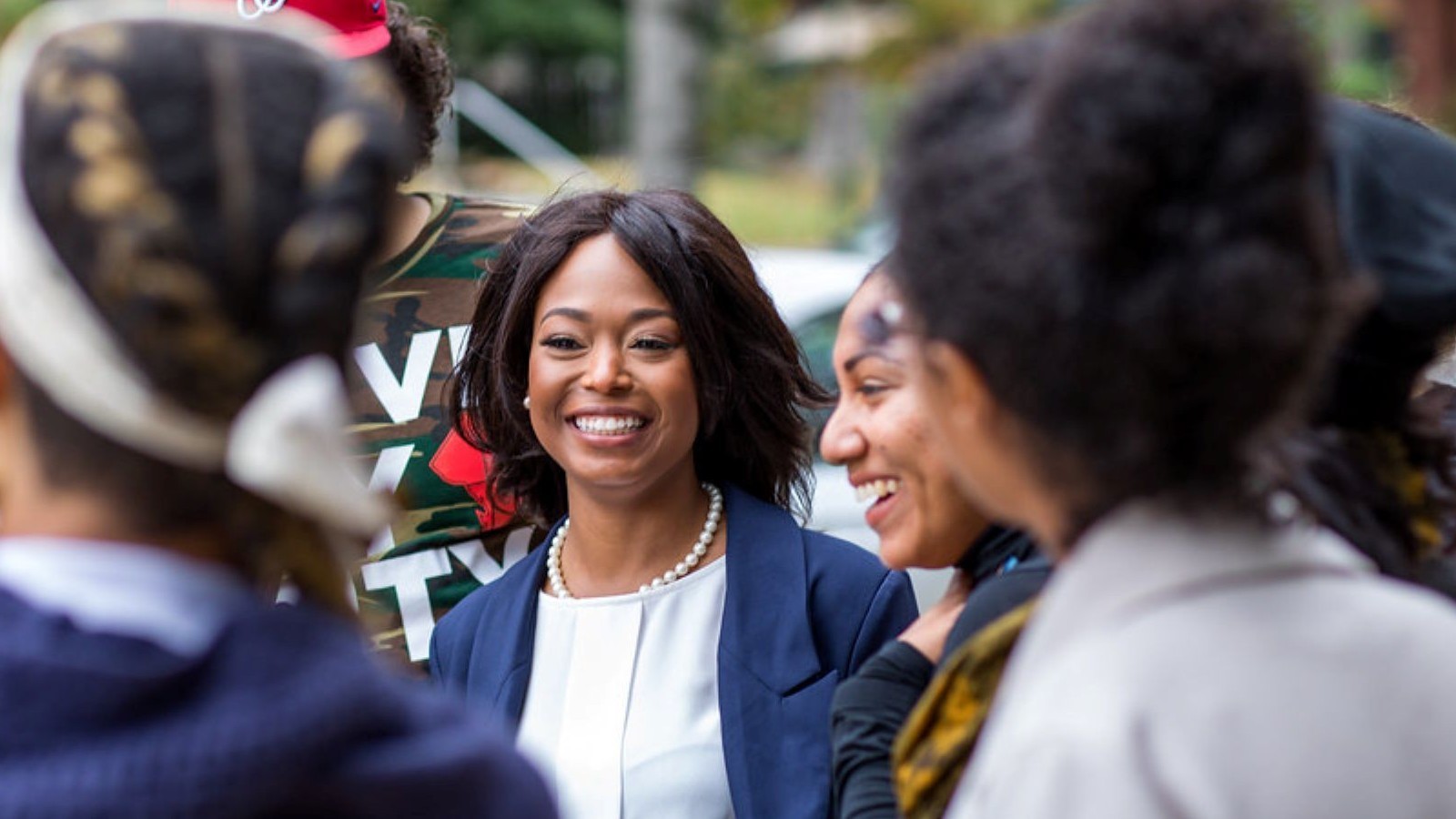
D.C. Mayor Recap: Lewis George Was the Heavy Favorite, and She's Out in Front
- Janeese Lewis George holds a commanding lead in the D.C. Democratic primary for mayor. She had about 53% of first-choice votes to Kenyan McDuffie's 37% with roughly two-thirds counted, enough to be the apparent winner.
- The market saw it coming. Polymarket made Lewis George about a 90% favorite to win the nomination and Kalshi had her near 91%, even though pre-election polls were much tighter.
- It is not official yet. D.C. used ranked-choice voting for the first time, the count is not done, and the Board of Elections does not expect its next update until Sunday. The Associated Press has not called the race.
- If her share stays above 50%, she wins outright with no ranked-choice rounds. She sits just above that line now, at about 52.8% of first choices.
- The general election is a formality in a city about 75% Democratic, though a Lewis George win would set up a democratic socialist mayor against a hostile Trump administration.
WASHINGTON, D.C - The bettors had this one right again. Janeese Lewis George, a Ward 4 D.C. Council member and democratic socialist, holds a commanding lead in the Democratic primary for mayor, and the prediction markets had treated her as the heavy favorite all along. She is not the certified winner yet, but she is the clear one.
With about two-thirds of the vote counted, Lewis George had roughly 53% of first-choice votes. Kenyan McDuffie, a former at-large council member running as a moderate, sat at about 37%. No other candidate in the seven-person field topped 3%.
The Market Was Never Worried
On the betting side, this was not a close call. When we previewed this race, Polymarket priced Lewis George at about 90% to win the nomination, and Kalshi had her near 91%. Her support on those platforms barely moved as voting neared.
That confidence is worth a note, because the public polls were tighter. Late surveys had the two candidates within single digits, with a large block of voters undecided. The market looked past that and treated Lewis George as the strong favorite. The early returns backed the market, not the cautious polls, with Lewis George leading McDuffie by about 16 points.
It helps to keep the numbers straight here. The market figure, around 90%, was her chance to win. The 53% is her share of first-choice votes. And the 50% line is the bar she needs to clear to avoid extra counting rounds.
Why It Is Not Official Yet
D.C. used ranked-choice voting for the first time this year, and the rollout is slowing the count. Under the system, a candidate needs more than 50% of the vote to win a race with three or more contenders. If no one clears that bar on first choices, the Board of Elections reallocates votes from the lowest finishers until someone does.
Lewis George is sitting just above that line, at about 52.8% of first choices. If that holds as the rest of the ballots are counted, she wins outright, and the ranked-choice rounds never run. If she slips below 50%, the reallocation begins, and her lead would make her the heavy favorite to win that too.
Either way, this will take time. The Board of Elections said it does not expect to release more results until Sunday. It is still counting mail ballots postmarked by Tuesday, and certification is not expected until mid-July. The Associated Press has not called the race.
A Two-Person Race in the End
Despite the crowded ballot, the contest came down to two people. Lewis George and McDuffie are both native Washingtonians and former prosecutors who served together on the council, but they ran on different visions. Lewis George leaned into a progressive platform built around housing costs, child care and lower utility bills. McDuffie pitched himself as the steadier, more moderate choice on public safety and the economy.
The rest of the field, including Gary Goodweather, Rini Sampath and Vincent Orange, never broke through, each landing around 3% or less. At 38, Lewis George would be one of the District's youngest mayors, and her rise echoes the win by New York Mayor Zohran Mamdani, another young democratic socialist who took over a big city.
The General Election and the Trump Factor
For November, the math is simple. The District is about 75% registered Democrats, so the Democratic nominee is all but certain to win the seat. That makes Lewis George the overwhelming favorite to be the city's next mayor, assuming her lead holds.
The twist is the backdrop, even without a real Republican threat. President Donald Trump has clashed with D.C. leaders and floated taking more federal control of the city. A democratic socialist mayor would be a sharp contrast with the White House, and Lewis George has said she will not back down. None of that changes the betting picture much, though, because the general election here is not a competitive market.
The Odds Board
For the betting audience, D.C. has been a clean run for the favorites. Lewis George, near 90% on Polymarket, is leading the mayor's race. Robert White, who sat around 81%, already won the delegate primary. Attorney General Brian Schwalb won renomination as well.
Anyone who backed the chalk in the District had a good night. The only suspense left is procedural: whether Lewis George finishes above 50% on first choices, or whether the city's new ranked-choice math has to do the job for her. For the wider picture, the gap between the cautious polls and the confident markets is the lesson worth filing away.
The Bottom Line
Lewis George is the apparent winner of the D.C. mayoral primary, even if the city's first ranked-choice count is not finished. The market had her as a roughly 90% favorite, the polls underrated her, and the early returns have her over the line.
For the latest election odds, the result is close to settled. If her majority holds through the weekend count, D.C. will have its next mayor in waiting, and the ranked-choice rounds will never be needed.