
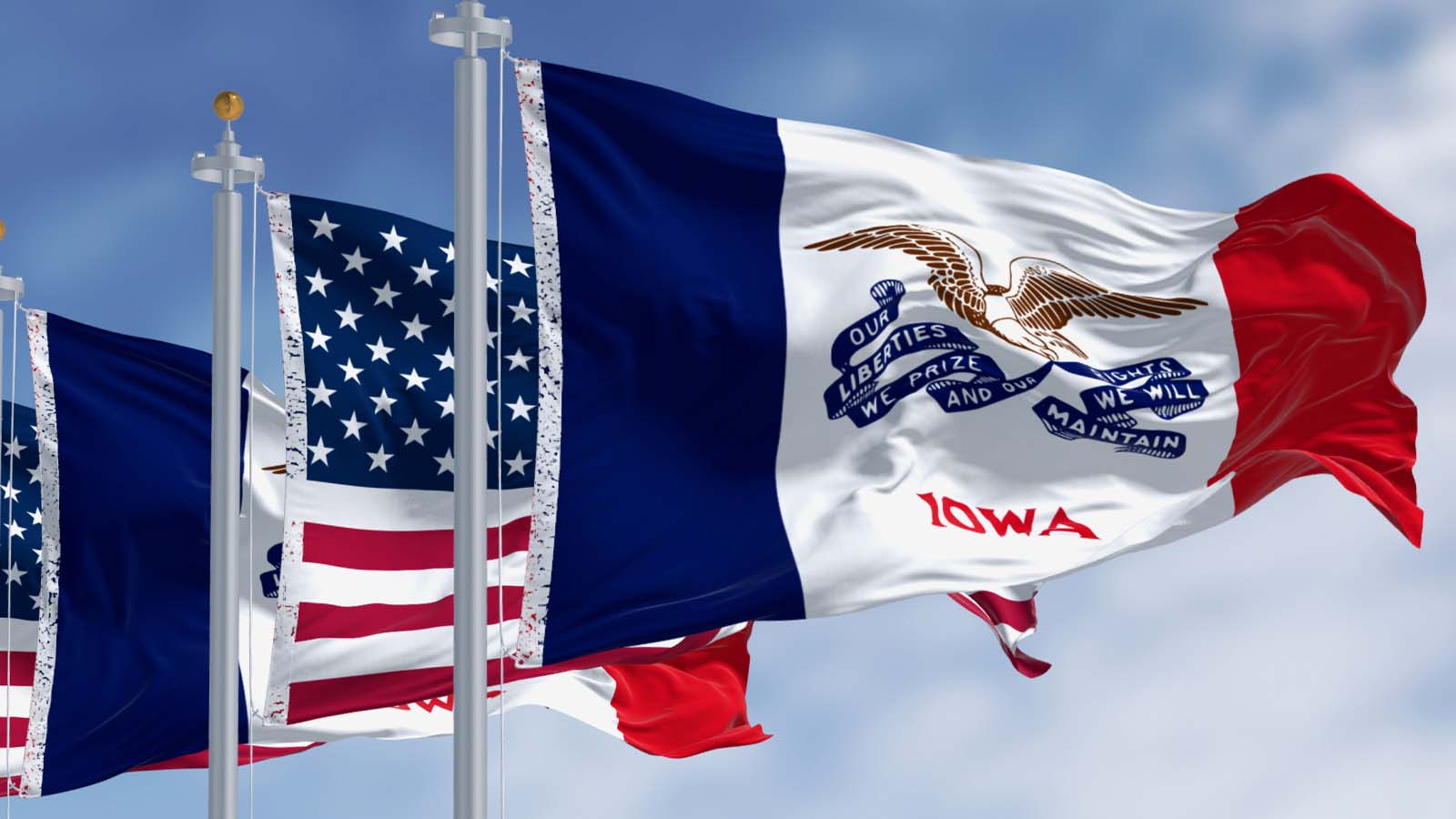
- Iowa’s June 2 primary will set the nominees for an unusually competitive slate of races. Both the governor’s seat and a U.S. Senate seat are open for the first time since 1968.
- Kalshi gives Democrats a 64% chance of winning the governor’s office — a stunning figure in a state Trump carried by about 13 points in 2024. Democratic state Auditor Rob Sand is running unopposed in the primary.
- The Senate race is the reverse: Kalshi and Polymarket both give Republicans a 62% edge, with Rep. Ashley Hinson nearly certain to win the GOP nomination against token opposition.
- Three Iowa U.S. House seats — IA-1, IA-2, and IA-3 — are rated as competitive or better by national forecasters. Two are listed among Kalshi’s tracked House general election markets.
- Iowa carries more election odds weight than almost any state its size — with five top-of-ticket and congressional races that could each move on a single primary result.
DES MOINES, Iowa — Iowa holds its primary election on June 2. The state is carrying more competitive weight than at any point in a generation.
Both statewide seats are open. Three congressional districts are in play. And the election odds in at least one race are flipping everything observers thought they knew about Iowa’s political trajectory.
Governor: Democrats Favored in Deep-Red Iowa
Kalshi gives Democrats a 64% chance of winning Iowa’s governor’s race in November. Polymarket is even more bullish on Democrats at 67%.
That is a remarkable number. Trump carried Iowa by about 13 points in 2024. The state has not elected a Democratic governor since Tom Vilsack in 2002.
The reason for the Democratic edge at sites with election odds in Iowa is Rob Sand. The state auditor is running unopposed in the June 2 Democratic primary. He is Iowa’s only statewide-elected Democrat. He won reelection in 2022 even as Republicans swept every other statewide office.
Cook Political Report recently moved the race to toss-up. Democrats have also posted large overperformances in Iowa state legislative special elections throughout 2025, helping break the GOP’s supermajority in the state Senate.
The Republican Primary: Feenstra Leads, Lahn Surging
Randy Feenstra, who is giving up his congressional seat to run, leads the GOP primary at 76% on Kalshi. But the race is not settled.
Businessman Zach Lahn sits at about 30% on Kalshi after reporting stronger fundraising than Feenstra in recent FEC filings. Feenstra also skipped the final televised debate ahead of the primary.
The rest of the field — including state Reps. Eddie Andrews and Brad Sherman, and former state official Adam Steen — trails well behind both frontrunners.
Rob Sand
Sand is a former assistant attorney general who upset a Republican incumbent in 2018 to become Iowa’s state auditor. He won reelection in 2022, becoming the only Democrat to hold statewide office in Iowa.
His family donated $7 million to his campaign fund when he announced. He has been raising issues around Iowa’s state finances, which he calls a “fiscal time bomb,” while Republicans have tagged him as an extreme liberal.
Senate: Republicans Lead, but Democrats Sense an Opening
The Iowa Senate race will give Democrats another shot at an open seat. Incumbent Joni Ernst announced she would not seek a third term — a decision that came after a public backlash over comments she made at a town hall about Medicaid cuts.
Rep. Ashley Hinson quickly consolidated the Republican field and is at 99% on Kalshi to win the GOP nomination. Her only primary opponent is former state Sen. Jim Carlin.
Kalshi and Polymarket both give Republicans a 62% chance of holding the seat in November, with Democrats at 38%. That reflects a competitive but Republican-leaning race in a state with a built-in GOP structural advantage.
The Democratic primary features state Rep. Josh Turek and state Sen. Zach Wahls. Turek leads Wahls at 88% to 14% on Kalshi. A third candidate, Nathan Sage, also filed but has not registered in prediction markets.
Polls show both Turek and Wahls running competitively against Hinson in general election matchups, with margins within a few points. The winner of Tuesday’s primary will immediately become one of the most-watched Senate challengers in the country.
House: Three Seats in Play, One Near-Toss-Up
Iowa’s 1st Congressional District is the most competitive House seat in the state. Rep. Mariannette Miller-Meeks won reelection in 2024 by just 799 votes — one of the narrowest margins in the country.
Democrat Christina Bohannan is running against her for a third time. Cook Political Report has moved the race to toss-up. An internal Democratic poll from early 2026 had Bohannan leading Miller-Meeks 43% to 39%.
In Iowa’s 3rd District, Rep. Zach Nunn won by less than four points in 2024. He will face state Sen. Sarah Trone Garriott, who outraised him in the most recent FEC reporting period. Kalshi lists both IA-1 and IA-3 among its tracked competitive House markets.
The 2nd District also becomes competitive now that Hinson is leaving for the Senate race. Her seat, which covers the Cedar Rapids area, was won by 16 points in 2024 but will be an open-seat contest in November.
The Bottom Line
Iowa is carrying more weight in the 2026 midterms than almost any other state. Both statewide seats are open. Three congressional districts are in play. And the markets are pricing the governor’s race as a Democratic tilt in a state Trump just won by double digits.
The Senate race is tilted Republican but not settled. The House races will depend heavily on whether Democratic enthusiasm translates into turnout.
For bettors watching Iowa’s election odds in 2026, Tuesday’s primary sets the table. Watch who wins the Democratic Senate primary — and whether Lahn can close on Feenstra before the votes come in.
Iowa’s primary is June 2, 2026. The general election is November 3, 2026.