
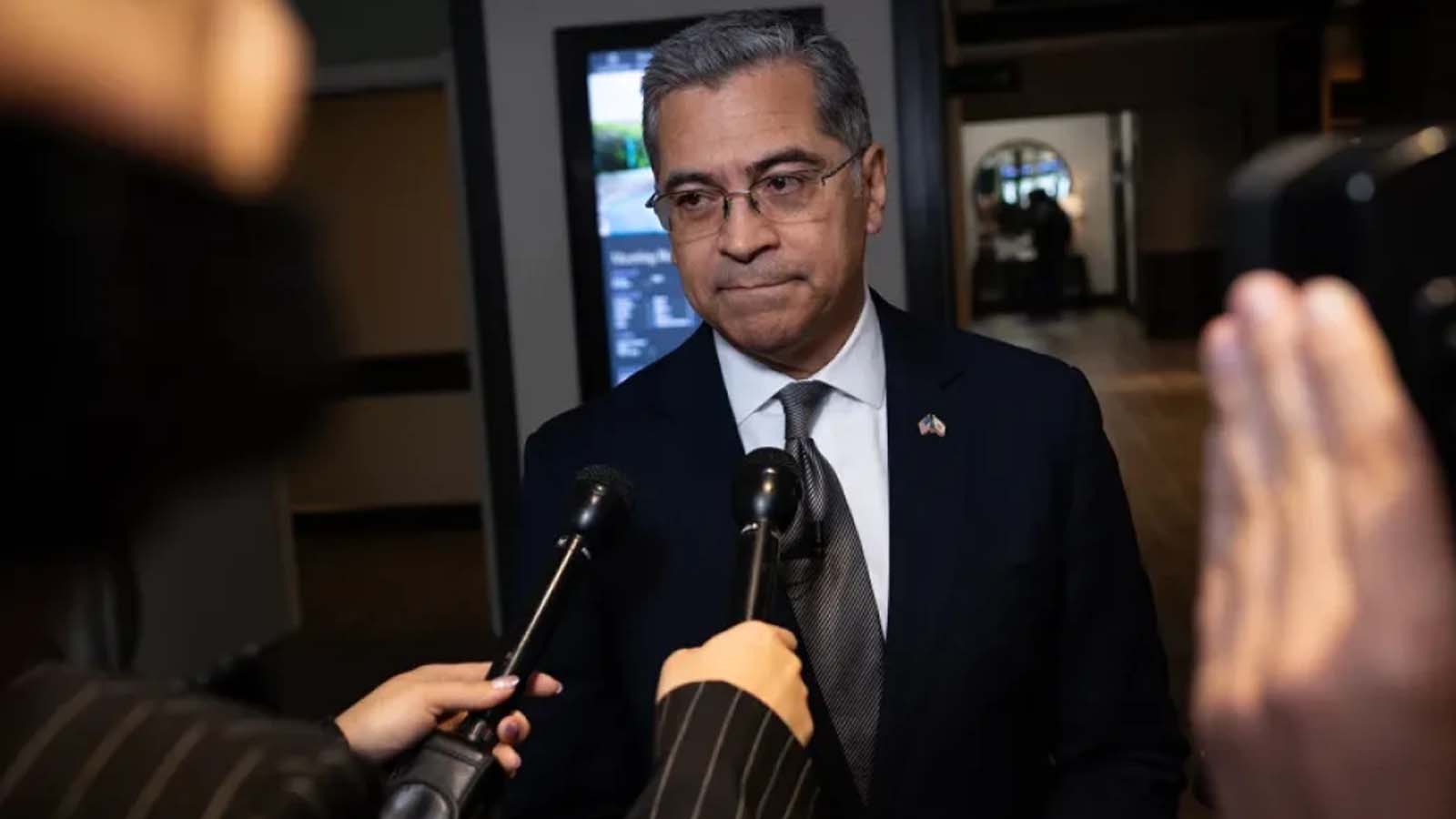
- Xavier Becerra led California’s governor primary with about 25.8% of the vote, with Steve Hilton at 26.7% and Tom Steyer at 19.6%, with roughly half the expected vote counted as of late Tuesday night.
- The race for the second general election spot was too close to call Tuesday night. California mail ballots typically shift toward Democrats as counting continues, giving Steyer’s campaign reason to wait.
- Prediction markets had priced Becerra as the most likely winner of the full race at 69% on Kalshi before the primary. A Becerra vs. Hilton November matchup would keep Democrats as the heavy November favorite.
- If Hilton advances instead of Steyer, or if both Republicans somehow advance, the election odds for the governorship shift dramatically — a two-Republican November would be the biggest upset in California politics since 2006.
- Sen. Alex Padilla advanced easily in the Senate primary. That race is safe Democratic and is not expected to be competitive in November.
LOS ANGELES — California’s top-two primary delivered exactly the kind of suspense that prediction markets had been pricing for months.
As of late Tuesday night, with roughly half the expected vote in, Democrat Xavier Becerra and Republican Steve Hilton were leading the governor’s race. Becerra had about 25.8% of the vote. Hilton was slightly ahead at 26.7%. Democrat Tom Steyer sat in third at 19.6%.
No race was called by major news organizations. California’s late-arriving mail ballots typically shift toward Democrats. Both Becerra and Steyer’s camps were urging supporters to be patient.
What the Markets Had Priced Before the Vote
Heading into Tuesday, election odds in California gave Democrats an 83% chance of winning the governorship in November. Becerra was priced at 69% to win the whole race, reflecting his strong pre-primary position.
Hilton was priced at 12% to win the governorship and roughly 75% to advance through the primary. Steyer sat at 19% overall. Those numbers made a Becerra-Hilton November matchup the most expected outcome.
The markets also assigned about a 27% chance to a two-Republican November, which would have locked every Democrat out of the ballot entirely. Early returns suggest that nightmare scenario did not happen. But it was closer than many Democrats wanted.
How We Got Here: Swalwell’s Exit Changed Everything
For most of the year, Rep. Eric Swalwell led this race. Then, in April, he dropped out following sexual misconduct allegations from multiple women, including a former staffer. He denied the allegations.
His exit scrambled the field. Becerra, who had been an afterthought in most polls, surged. Kalshi moved him from below 1% to the top of the market within weeks.
Steyer spent heavily on TV advertising and used his personal wealth to try to stay competitive. But polling in the final week showed him falling behind both Becerra and Hilton. That’s where the early returns left things Tuesday night.
Why the Second Spot Is So Important
California’s top-two primary means both November candidates come from the same ballot, regardless of party. The identity of the second candidate changes everything about the fall race.
If Becerra and Hilton advance, the November matchup is a standard Democrat vs. Republican contest. In that scenario, California’s D+13 partisan lean makes Becerra the strong favorite. Kalshi has already priced Democrats at 83% in a normal matchup.
If Hilton and Steyer both advance, Democrats would still be in the race — but Steyer brings a weaker general-election profile than Becerra. Markets would likely shift slightly toward Hilton in that scenario.
If two Republicans somehow advance — which early returns suggest did not happen — the governorship would almost certainly go to a Republican for the first time since Arnold Schwarzenegger’s reelection in 2006.
Where Hilton and Becerra Stand
Becerra is the former California attorney general and former U.S. Secretary of Health and Human Services under President Biden. His surge after Swalwell’s exit was one of the fastest market moves of the 2026 cycle. His governor odds went from barely registering on prediction markets to the outright leader in under four weeks.
Hilton is a British-born former Fox News host who received Trump’s endorsement in April. He performed well with Republican voters and crossover independents. His early lead in the vote count reflects strong Election Day turnout among in-person Republican voters.
The gap between Hilton and Becerra — less than one percentage point in early returns — is well within the range that California’s late-counted mail ballots could close or reverse.
Senate: Padilla Advances, Nothing to Bet On
Sen. Alex Padilla advanced in the Senate primary as expected. He is the heavy favorite to win reelection in November. Kalshi, and other prediction markets with Senate election odds, do not list California’s Senate race among its competitive general election markets.
Republicans have not won a California Senate seat since 1988. There is no realistic scenario where that changes this November.
What Happens to the Odds Now
Prediction markets will reprice the California governor’s race as vote counting continues over the next several days and weeks. California does not certify results quickly — mail ballots postmarked by June 2 have until June 9 to arrive.
If Becerra and Hilton are confirmed as the two finalists, the election odds will revert to something close to the 83-17 Democratic advantage that Kalshi had before the primary. California’s partisan composition simply does not favor a Republican in a two-way fall race.
The question that keeps the race interesting is whether Steyer’s late-arriving ballots can close the gap with Hilton for second place. If they do, November becomes a different kind of race. If they don’t, Hilton and Becerra head to November in what election odds suggest to be a non-competitive race.
Final California primary results are expected over the coming days as mail ballots are counted. The general election is November 3, 2026.