
Every congressional special election in the 119th Congress, the Democratic overperformance pattern across the cycle, live odds for upcoming races, and a state-legislative roundup. Sourced from Ballotpedia, AP reporting, and live Polymarket and Kalshi prediction markets.
The Story: Democratic Overperformance
Democrats have not flipped a single Republican-held congressional seat in the 2025-26 special election cycle. They also have not needed to. The pattern of the cycle is that Democratic candidates are massively outrunning Kamala Harris's 2024 numbers in every district that has gone to the voters, regardless of which party holds the seat. The average Democratic swing across the seven congressional specials with party-vs-party comparisons is +16.1 points. State legislative specials show the same pattern: per Wikipedia's tracking, Democrats have averaged a 10-point overperformance against Harris's 2024 baseline across all 2025-26 state legislative specials, flipping five seats nationally including in districts Trump won by double digits.
If a 13-to-18-point Democratic swing held nationally on November 3, 2026, it would put an additional 10 Republican House seats in serious jeopardy. That is the warning sign Republican strategists have been quietly flagging since the Tennessee 7th result in December, the Georgia 14th runoff in April, and the New Jersey 11th in mid-April: every special is a Democratic overperformance, in every region, against every district type.
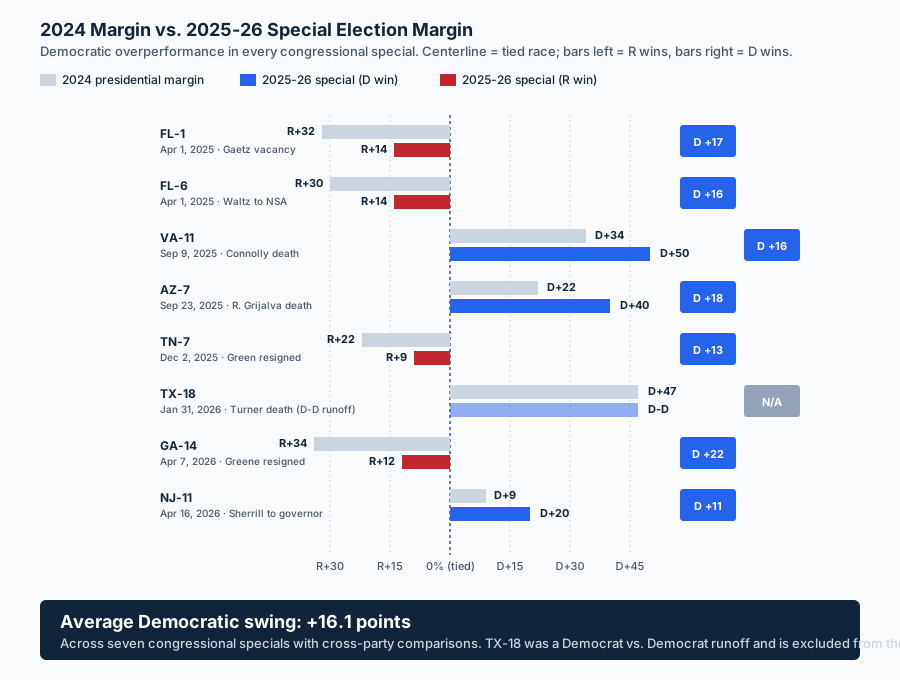
Congressional Specials Held in the 119th Congress
Eight congressional special elections have been held in the current Congress. No seat has changed party hands, but all seven races with cross-party comparisons saw double-digit Democratic overperformance against Donald Trump or Kamala Harris's 2024 numbers in the same district.
| Date | District | Vacancy | Winner | Special Margin | 2024 Margin | Dem Swing |
|---|---|---|---|---|---|---|
| Apr 1, 2025 | FL-1 | Gaetz resigned | Patronis (R) | R+14 | R+32 | D +17 |
| Apr 1, 2025 | FL-6 | Waltz to NSA | Fine (R) | R+14 | R+30 | D +16 |
| Sep 9, 2025 | VA-11 | Connolly died | Walkinshaw (D) | D+50 | D+34 | D +16 |
| Sep 23, 2025 | AZ-7 | R. Grijalva died | A. Grijalva (D) | D+40 | D+22 | D +18 |
| Dec 2, 2025 | TN-7 | Green resigned | Van Epps (R) | R+9 | R+22 | D +13 |
| Jan 31, 2026 | TX-18 | Turner died | Menefee (D) | D-D | D+47 | N/A |
| Apr 7, 2026 | GA-14 | Greene resigned (Epstein rift) | Fuller (R) | R+12 | R+34 | D +22 |
| Apr 16, 2026 | NJ-11 | Sherrill to NJ governor | Mejia (D) | D+20 | D+9 | D +11 |
Upcoming Specials & Live Odds
As of May 2026, five House seats are currently vacant (CA-1, CA-14, FL-20, GA-13, TX-23), with special election dates set or pending. Two Senate specials are scheduled for the November 3, 2026 general election: Florida (Rubio's seat, now held by appointed Senator Ashley Moody) and Ohio (Vance's seat, now held by appointed Senator Jon Husted). The Oklahoma Senate seat vacated by Markwayne Mullin's appointment as Homeland Security Secretary will be filled in the regular November 2026 election under Oklahoma's appointment law, with appointee Alan Armstrong barred from running.
Likely R (old map)
Safe D
Safe D
Safe D
Lean R
Likely R
Toss-up
Live Special Election Markets
Live prediction market odds for the upcoming specials from Polymarket and Kalshi. Probabilities update on every fetch and represent the implied probability of the listed outcome.
State Legislative Specials
Sixty-three state legislative special elections have been scheduled across 22 states for 2026. The pattern mirrors the federal results: Democrats overperforming in district after district, including in red and rural seats they would have written off in 2024. Below are the notable recent flips and overperformances.
| Date | State / District | Result | Story |
|---|---|---|---|
| Jan 28, 2025 | Iowa SD-35 | Dem flip | Mike Zimmer (D) won in a Trump +21 district, an early red flag of the cycle that became the first state Senate flip of the year. |
| Apr 1, 2025 | WI Supreme Court | Liberal hold | Susan Crawford defeated Brad Schimel by 10 points after $100 million-plus in total spending. Widely interpreted as the largest off-year vote on Elon Musk's role in the Trump administration. |
| Dec 30, 2025 | Iowa state Senate | Broke GOP supermajority | Renee Hardman (D) won a December special, becoming the first Black woman to serve in the Iowa Senate and blocking the GOP from reclaiming a supermajority. |
| Jan 6, 2026 | VA state Senate (Richmond) | Dem hold | Democrats defended the seat vacated by Lt. Gov.-elect Ghazala Hashmi, preserving the new Democratic trifecta in Virginia. |
| Jan 2026 | Minnesota House 47A | Tie preserved | Meg Luger-Nikolai won a majority-deciding special, keeping the Minnesota House tied 67-67 heading into the 2026 cycle. |
| Feb 2026 | Texas SD-9 (Fort Worth) | Dem flip | Taylor flipped a Fort Worth-area state Senate seat that Republicans had held for over 30 years. |
| May 5, 2026 | Michigan SD-35 | Dem hold | Chedrick Greene (D) won 60-40 in a Harris +1 district, an approximate 20-point Democratic swing. The win preserved the Michigan Senate's one-seat Democratic majority. |
Across all 2025-26 state legislative specials, Democrats have outperformed Kamala Harris's 2024 baseline by an average of 10 percentage points and flipped five seats nationally, including in districts Trump won by double digits. The Democratic Legislative Campaign Committee has won majority-deciding specials in at least five chambers (Minnesota House, Virginia Senate, Pennsylvania House, Iowa Senate, Michigan Senate) since November 2024.
What 2025 Specials Tell Us About the 2026 Midterms
Special elections are one of the most reliable leading indicators of a midterm wave. The 2017-18 cycle saw Democratic overperformance averaging around 10 points and produced a 41-seat House gain. The 2021-22 cycle saw Republican overperformance averaging around 7 points and produced a modest GOP House gain. The 2023-24 cycle saw mixed results that foreshadowed Trump's narrow popular vote victory and Republican Senate gains.
The 2025-26 cycle is producing Democratic overperformance averaging +13 points across all races, and +17 points across the congressional specials. Both figures are unusually high relative to recent history. The closest historical comparisons are 2017 and 2009, cycles that produced the 2018 Democratic House majority and the 2010 Republican wave, respectively. The structural common element across these cycles: a sitting president whose party also held Congress and whose approval rating was underwater.
President Trump's approval rating sits at roughly 36% nationally as of May 2026, with disapproval near 57%, a net negative 21 points. The party in power has lost House seats in 18 of the last 20 midterm cycles. Specifically: when the in-party president has an approval rating below 50% on Election Day of the midterm, that party has averaged a net loss of 37 House seats since 1946. The current Republican majority is 217-213 with five vacancies, meaning a net Democratic gain of just three seats would flip control of the chamber.
The two Senate specials in November will be the highest-profile test cases. In Florida, appointed Senator Ashley Moody (R) faces Democratic challengers including Alex Vindman and Angie Nixon. Polymarket gives the Republican nominee a comfortable lead, reflecting the state's recent Republican lean. In Ohio, the special election to replace Vance has become a genuine toss-up. Former Senator Sherrod Brown (D) is running against appointed Senator Jon Husted (R). Polymarket prices the Democratic nominee at roughly 57%, a position the market only reached after flipping from a Republican-favored 76% in March 2026. If Brown wins, Democrats will have flipped a seat the prediction markets considered safely Republican as recently as the spring.
A third Senate dynamic is the Oklahoma seat. After Markwayne Mullin was confirmed as Homeland Security Secretary in March 2026, Governor Kevin Stitt appointed energy executive Alan Armstrong to the seat. Under Oklahoma law, Armstrong is prohibited from running in the November 2026 election that determines the seat for the rest of the term, leaving the Republican primary open. Oklahoma is not technically holding a separate special election; the seat is being filled on the regular November ballot.
Prediction markets are pricing the House at roughly 80% Democratic and the Senate as a toss-up with Democrats slightly favored. Special election results, both congressional and state legislative, are why.
How Special Elections Work
What triggers a special election?
A special election is held to fill a congressional vacancy that occurs between regularly scheduled general elections. Common triggers include death of an incumbent (Connolly, Grijalva, Turner), resignation to take a cabinet or administration role (Gaetz, Waltz, Rubio, Vance), resignation under ethics or criminal pressure (Cherfilus-McCormick's indictment), or election to another office. Retirement or non-re-election typically does not trigger a special - the seat simply waits for the next regular election. That is why NY-21 (Stefanik) and several California open seats are 2026 regular races, not specials.
Who decides when the special election happens?
For House vacancies, the state governor typically issues a writ of election within a window specified by state law, usually 10 days. The election itself must be held within a state-specific window, often 60 to 90 days after the writ. Senate vacancy procedure varies widely by state. Some states (Florida, Ohio) require an immediate gubernatorial appointment followed by a special election at the next federal cycle. Others (Hawaii, Oregon) allow the appointed senator to serve out the full unexpired term. This is why both the Rubio (FL) and Vance (OH) seats produced gubernatorial appointments first, with the special elections set for November 3, 2026.
Why do governors appoint Senate replacements but not House replacements?
The Seventeenth Amendment (1913) explicitly authorizes governors to make temporary appointments to fill Senate vacancies. No equivalent provision exists for the House - Article I, Section 2 requires House vacancies to be filled by election. The constitutional asymmetry exists because the framers viewed the House as the body that derives its legitimacy directly from popular vote, whereas the Senate has had a more attenuated relationship with popular sovereignty (senators were chosen by state legislatures until 1913).
How often do special elections flip seats?
Special elections rarely flip safely-held seats. Of the six congressional specials in the 119th Congress, zero have changed party hands. The story is usually the margin: Democrats winning a Trump +37 district by only 14 points, or holding a Harris +22 district by 40 points, is what predicts the broader political climate. The exceptions tend to be when a seat sits in a true swing district (PA-12 in 2023, NY-3 in 2024) where any swing can produce a flip.
What is "overperformance" and how is it measured?
Overperformance compares the margin of a special election to a baseline margin in the same district. The two most common baselines are the most recent presidential margin (used here: Trump or Harris's 2024 vote in the district) and the most recent regular congressional margin. The Downballot, a publication that tracks special elections, uses both. A "+18 Democratic swing" in AZ-7 means Adelita Grijalva ran 18 points ahead of Kamala Harris's 2024 numbers in the same district. Overperformance is widely considered the single best predictive variable for the next general election.
Are state legislative specials predictive too?
Yes, and often more granularly than congressional specials because there are so many more of them. The 50-of-60 Democratic overperformance figure cited above includes a mix of state House, state Senate, and county-level specials. Daily Kos and The Downballot publish weighted swing averages that have historically correlated within 1-2 points of the actual midterm popular vote. Iowa Senate District 35 in January 2025 - a 25-point Democratic swing in a Trump +21 seat - was the first major signal that the cycle would be unusually anti-Republican.
Why are some specials non-partisan?
Several states (Texas, Louisiana, Georgia in some contexts) use a "jungle primary" structure where all candidates compete on a single ballot regardless of party, with a runoff between the top two if no candidate clears 50%. The TX-18 special followed this structure. Christian Menefee and Amanda Edwards, both Democrats, advanced to the January 2026 runoff, which Menefee won. Because both finalists shared a party, no Democrat-vs-Republican swing comparison was possible for that race.
Methodology & Sources
Click on any of the states below to find information about the special elections in that state. If there are any special elections in the state then they will be covered. If you do not see anything about special elections then there are none in your state, at least not that have any prediction markets.
- Alabama
- Alaska
- Arizona
- Arkansas
- California
- Colorado
- Connecticut
- Delaware
- District of Columbia
- Florida
- Georgia
- Hawaii
- Idaho
- Illinois
- Indiana
- Iowa
- Kansas
- Kentucky
- Louisiana
- Maine
- Maryland
- Massachusetts
- Michigan
- Minnesota
- Mississippi
- Missouri
- Montana
- Nebraska
- Nevada
- New Hampshire
- New Jersey
- New Mexico
- New York
- North Carolina
- North Dakota
- Ohio
- Oklahoma
- Oregon
- Pennsylvania
- Rhode Island
- South Carolina
- South Dakota
- Tennessee
- Texas
- Utah
- Vermont
- Virginia
- Washington
- West Virginia
- Wisconsin
- Wyoming
Methodology & Sources
Live odds are pulled twice daily from Polymarket's Gamma API and Kalshi's public markets API for events where the title or tags indicate a U.S. congressional special election. Implied probabilities are computed from each market's most recent best-bid or last-trade price (whichever is current). For multi-outcome events, the highest-probability outcome is shown first.
Historical results come from Ballotpedia's Special Elections to the 119th Congress compilation, cross-referenced against AP and Decision Desk HQ projections. The 2024 presidential margins by congressional district are from The Downballot's calculations, sponsored by Grassroots Analytics. The +13-point average swing figure is from Democratic pollster Molly Murphy's tracking of all 60 specials at every level during 2025, as cited in E.J. Dionne's December 2025 Brookings analysis.
Editorial framing reflects publicly available reporting from AP, Reuters, The Washington Post, NBC News, CNN, Brookings, and SCOTUSblog (for any specials that arose from administration cabinet vacancies). State legislative results come from individual state board of elections data via Daily Kos Elections weekly tracking.
Page last reviewed for accuracy: May 26, 2026. Live odds refresh on the next scheduled fetch.