
Nine states have new congressional maps locked in for 2026 after Louisiana finalized its post-Callais redraw on May 29. Alabama's GOP map remains blocked by a federal panel and is now headed to the Supreme Court. South Carolina's Senate rejected its own redistricting plan May 26. Live prediction-market odds, state-by-state status, and the projected House seat impact in one place.
Live Redistricting Prediction Market Odds
Kalshi runs three active markets covering the mid-decade redistricting wars: a numeric range market on how many states will redistrict before the midterms, and Yes/No markets on each individual state for the 2026 and 2028 cycles. Below are the live odds, updated twice daily.
Seat Impact: Where Redistricting Is Tilting the House
The chart below shows projected House seat changes from each state's new or proposed map, relative to the seats those states sent to Congress in 2024. Republican-tilting changes appear in red, Democratic-tilting in blue. The combined projected GOP swing across all states with new maps is +10 to +15 seats - roughly the size of the current Republican House majority.
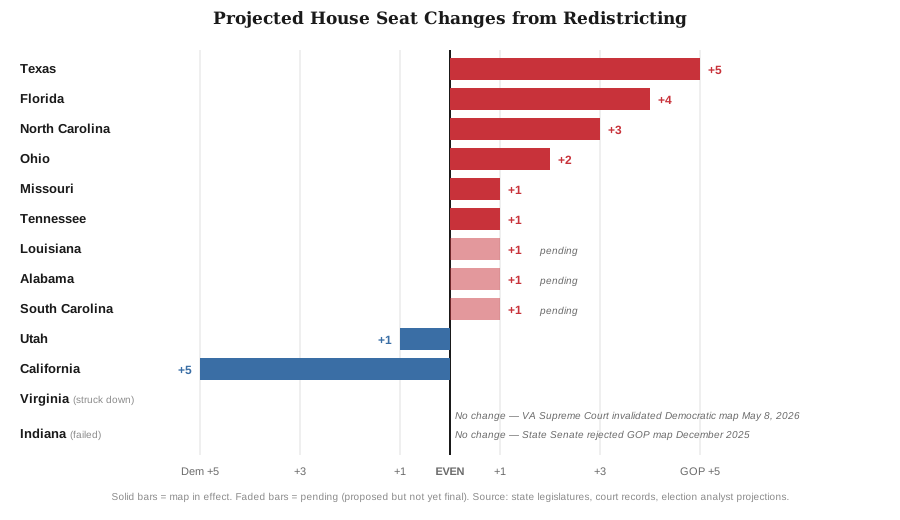
The bottom line: Republicans have picked up a projected +15 net seats from completed redistricting once Louisiana is added, roughly +20 from red-state maps offset by California's +5 Democratic response. That's almost exactly the size of the current 217-212 GOP House majority. If the Supreme Court reverses the Alabama ruling on emergency appeal, the number climbs to +16. If Alabama's block holds, the number stays at +15.
The Timeline: From Texas to the Callais Earthquake
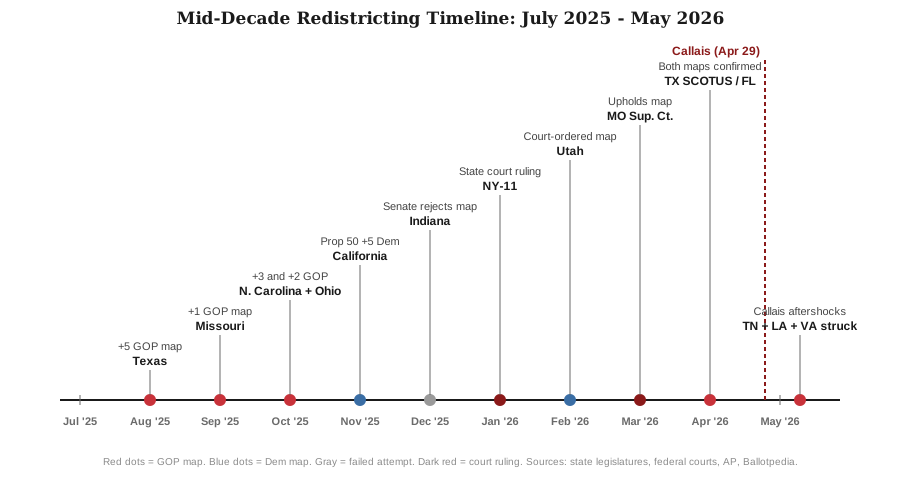
The current mid-decade redistricting wave traces to a Trump letter sent to Texas Governor Greg Abbott in June 2025 demanding the state redraw its congressional map. The chronology below shows what came next.
State-by-State Status
The breakdown below covers every state that has taken formal redistricting action or has an active lawsuit affecting its congressional map ahead of the November 2026 midterm elections. Status as of May 24, 2026.
The map that started everything. Texas Legislature passed new districts in August 2025 after Trump pressured Abbott; Democrats walked out and lost. A federal three-judge panel struck down the map in November 2025 as a racial gerrymander, but the U.S. Supreme Court stayed that ruling in December and formally reversed it April 27, 2026, ensuring the new map is used in November.
Governor DeSantis called a special session for April 20-24, 2026 to redraw the state's congressional map. The Legislature passed his proposal April 29, the same day Callais was decided. DeSantis signed it May 4. The new map could push the Florida delegation from 20-8 GOP to 24-4 GOP. Voting-rights groups have vowed to sue.
The Republican-led legislature passed a new congressional map in October 2025. North Carolina is unusual in that the governor cannot veto redistricting bills under state law, so the simple-majority vote was sufficient. A federal court panel denied a request to block the new districts in November 2025, leaving the map in place for 2026.
Ohio's case is structural rather than partisan. The 2022 map was a temporary fix after the state Supreme Court struck down an earlier gerrymander, and the state constitution required a new map before 2026. A bipartisan commission approved the updated map in October 2025. It modestly improves Republican chances in two competitive districts.
The Republican-controlled legislature passed a new map in a September 2025 special session, targeting the Kansas City-area 5th District held by Democrat Emanuel Cleaver. The Missouri Supreme Court rejected one constitutional challenge in March 2026. A second case, Maggard v. Missouri, is pending, and a November 2026 veto referendum could overturn the map after the election.
Governor Bill Lee signed a new map May 7, 2026, eight days after the Callais decision. The map splits the Memphis-based 9th District (held by Democrat Steve Cohen, the state's only Democratic House member) across three new districts. The state also repealed a 1972 law that had previously banned mid-decade redistricting. Three federal challenges are pending, all assigned to the same judge.
An August 2025 state court ruling held that the Republican-drawn 2021 Utah map violated the state's voter-approved anti-gerrymandering law. The court ordered the state's independent districting commission to draw a new map, which created one Salt Lake City-anchored district that could be competitive for Democrats for the first time in over a decade.
After Texas passed its August 2025 map, Governor Newsom tweeted "two can play that game." California voters approved Proposition 50 in November 2025, suspending the state's independent commission for one cycle and authorizing a Democratic-drawn map. Federal courts denied multiple injunctions, and the U.S. Supreme Court refused to block the map in February 2026. The Texas SCOTUS ruling on April 27 effectively guaranteed the California map survives, since both maps were judged partisan.
Forced to redraw by the Callais ruling that invalidated its existing map, the Louisiana legislature gave final passage to Senate Bill 121 on May 29, 2026. The new map drops the state from two majority-Black districts to one. The dismantled district was the 6th, held by Democratic Rep. Cleo Fields; the surviving majority-Black district snakes from New Orleans through Baton Rouge and is held by Democratic Rep. Troy Carter. The delegation is expected to shift from 4R-2D to 5R-1D. House Speaker Mike Johnson, a Louisiana Republican, urged lawmakers to draw a 6R-0D map but was rebuffed over concerns that going further would make Johnson's and Majority Leader Steve Scalise's own seats competitive. Voting rights groups are expected to challenge the map. Roughly 40,000 ballots already cast in the suspended May 16 primaries were discarded; the new House primary is expected in mid-July.
A three-judge federal panel in Birmingham issued a preliminary injunction on May 26, 2026 blocking Alabama from using the Republican-drawn map for the November midterms. The panel ruled the map "intentionally discriminated based on race" and required the state to continue using the same court-ordered districts under which representatives were elected in 2024. Two of the three judges were Trump appointees. Alabama Attorney General Steve Marshall said the state would "immediately appeal" to the U.S. Supreme Court. If reversed, the GOP-favored 6R-1D map could still take effect. The decision sets up the first major test of how broadly the April Callais ruling reaches.
Governor Henry McMaster called the legislature back into special session after the regular session ended without a new map. The state House amended its redistricting legislation and passed it to the Senate on May 20, 2026. The Senate rejected the proposal on May 26, ending the 2026 push. Republicans had targeted the 6th District seat held by Democrat Jim Clyburn. McMaster has not publicly ruled out another attempt before November, but the rejection by his own party's Senate makes a 2026 map unlikely.
Democrats passed a referendum on April 21, 2026 authorizing a new Democratic-favored map (potentially +4 Dem seats). The Virginia Supreme Court struck the referendum down May 8 on procedural grounds, ruling that lawmakers violated constitutional rules for amendment timing. The U.S. Supreme Court denied an emergency appeal May 16, ending the effort. The current 6D-5R map remains in place.
Despite intense Trump pressure that included VP Vance making personal visits to state Republican leaders, the Indiana Senate rejected a proposed GOP redistricting plan in a bipartisan 31-19 vote on December 11, 2025. The House had passed it 57-41 a week earlier. Several Republican state senators publicly opposed mid-decade gerrymandering as a matter of principle.
A New York state court ruled in January 2026 that the 11th Congressional District, held by Republican Rep. Nicole Malliotakis, violated the state constitution by diluting the votes of Black and Hispanic residents. The U.S. Supreme Court intervened over the dissent of its three liberal justices, halting the state court ruling and preserving the current map for the 2026 midterms. Justice Samuel Alito wrote that the state judge's ruling amounted to "unadorned racial discrimination" in violation of the U.S. Constitution. Justice Sonia Sotomayor's dissent accused the majority of taking "the unprecedented step of staying a state trial court's decision in a redistricting dispute on matters of state law."
Mid-decade redistricting was attempted but failed or stalled in: Arkansas, Kansas, Mississippi, New Hampshire, Washington, and Wisconsin. Maryland and other blue states that explored a Democratic counter-response also failed to advance bills. In each case, divided legislative control, constitutional commission requirements, or simple political reluctance blocked the effort.
How Redistricting Actually Works
Who draws congressional maps varies state by state. The three main models below explain why some states can redistrict on a simple-majority vote of the legislature while others require a commission or court order.
Legislature-led
The majority party in the state legislature draws the map. The governor typically signs or vetoes, though in North Carolina the governor cannot veto redistricting bills at all. This is the most common model and the one used by Texas, Florida, Missouri, Tennessee, Louisiana, South Carolina, and Alabama.
Independent commission
An independent or bipartisan commission draws the map, typically insulated from direct legislative control. California, Arizona, Michigan, Washington, and Colorado use commissions, as does Ohio for state-legislative maps. California's voters temporarily suspended its commission in 2025 to enable mid-decade redistricting.
Court-ordered
State or federal courts can order redistricting when an existing map is found to violate the Voting Rights Act, the U.S. Constitution, or a state constitution. Utah's 2026 map was court-ordered after a state judge struck down the 2021 map. Louisiana's current redraw is also court-compelled, this time by SCOTUS in Callais.
2028 and Beyond
Most of the maps drawn in 2025 and 2026 are designed to be temporary fixes for one cycle, though some are written to last through the 2030 census. The questions that remain open as 2026 approaches:
Can blue states retaliate further? California has acted. Virginia tried and failed. Maryland, Illinois, and Massachusetts have all considered Democratic-favored redraws but have not advanced bills. The structural problem for Democrats: most blue states either use independent commissions (which their state constitutions require) or already have aggressive Democratic gerrymanders in place. There is less low-hanging fruit on the Democratic side.
Will Callais expand? The April 29 ruling formally applied only to Louisiana's specific map, but its reasoning is broad enough to invite challenges to majority-minority districts in many states. South Carolina, Alabama, Georgia, and other states with single Democratic seats anchored in majority-Black populations may see similar lawsuits before 2028.
What about the 2030 census? All current maps will be subject to mandatory redrawing after the 2030 census produces new state population counts. The 2030 cycle is expected to be the most contentious in U.S. history, given the precedents set in 2025-2026.
The Kalshi market on which states will redistrict before the 2028 elections is one of the few sources of forward-looking pricing on this question. As of the latest update, the most-priced states for further action are Maryland, Illinois, and Georgia, though specific market prices change daily.
Redistricting By State
- Alabama
- Alaska
- Arizona
- Arkansas
- California
- Colorado
- Connecticut
- Delaware
- District of Columbia
- Florida
- Georgia
- Hawaii
- Idaho
- Illinois
- Indiana
- Iowa
- Kansas
- Kentucky
- Louisiana
- Maine
- Maryland
- Massachusetts
- Michigan
- Minnesota
- Mississippi
- Missouri
- Montana
- Nebraska
- Nevada
- New Hampshire
- New Jersey
- New Mexico
- New York
- North Carolina
- North Dakota
- Ohio
- Oklahoma
- Oregon
- Pennsylvania
- Rhode Island
- South Carolina
- South Dakota
- Tennessee
- Texas
- Utah
- Vermont
- Virginia
- Washington
- West Virginia
- Wisconsin
- Wyoming
Frequently Asked Questions
What is mid-decade redistricting?
Congressional districts are usually redrawn once a decade, after the U.S. Census Bureau releases new population counts. Mid-decade redistricting is the practice of redrawing them outside that normal cycle. Before 2025, this had happened only twice voluntarily since 1970. The 2025-2026 wave is by far the largest mid-decade redistricting cycle in modern U.S. history.
Why is this happening now?
Two simultaneous catalysts. First, President Trump began publicly pressuring Republican-controlled states in June 2025 to redraw their maps to help the GOP hold its narrow House majority in 2026. Texas was the first to comply. Second, the Supreme Court's April 29, 2026 decision in Louisiana v. Callais gutted Section 2 of the Voting Rights Act, removing the major legal constraint on racial gerrymandering and triggering a second wave of Southern state redraws.
Is mid-decade redistricting legal?
Generally yes, though specific maps can be challenged. The U.S. Constitution gives states broad authority to set their own election rules, and the Supreme Court has held since Rucho v. Common Cause (2019) that purely partisan gerrymandering cannot be challenged in federal court. The remaining constraints - the Voting Rights Act and state constitutions - were significantly weakened by Callais and by various state-court rulings in 2025-2026.
How much will redistricting affect House control in 2026?
The combined projected GOP seat swing from completed and pending redistricting is roughly +10 to +15 seats, before any votes are cast. The current House majority is 217-212, so the redistricting alone is enough to offset a typical midterm "thermostatic" backlash against the party in power. Whether it is enough to actually preserve the GOP majority depends on the size of the wave Democrats can generate in November.
What is Section 2 of the Voting Rights Act, and what did Callais do to it?
Section 2 of the 1965 Voting Rights Act prohibits voting rules and electoral maps that discriminate on the basis of race. Before Callais, federal courts applied a multi-step "Gingles" test to determine whether a state had violated Section 2 by drawing maps that diluted minority voting power. Callais did not formally overturn Section 2 but raised the bar for plaintiffs so high that, in Justice Kagan's dissent, "today's decision renders Section 2 all but a dead letter." States can now create or eliminate majority-minority districts much more freely, as long as they invoke partisan rather than racial motives.
Can a state legislature just redraw the map any time it wants?
It depends on the state. Most states have no formal limit on how often the legislature can redraw congressional districts, though Tennessee had a state law banning mid-decade redistricting that the legislature simply repealed in May 2026 before passing its new map. States with independent redistricting commissions (California, Arizona, Michigan, Washington, others) require either a constitutional amendment or a ballot referendum to suspend the commission, which is why California needed Proposition 50.
Which states might still redistrict before November 2026?
Louisiana finalized its new post-Callais map on May 29, leaving no state actively in the redistricting process. Alabama's GOP map was blocked by a federal court on May 26 and now awaits the Supreme Court on emergency appeal; if SCOTUS reverses, the Alabama map takes effect for 2026. South Carolina's Senate rejected its House-passed redistricting plan May 26, effectively ending that effort for the 2026 cycle. Indiana's effort failed in December 2025 but could be revived. Other Southern states could move if Callais-related litigation creates an opening, though primary season is now too far along in most places for new maps to govern 2026 elections. The Kalshi prediction markets at the top of this page show the live odds on each state.
Will any of these new maps be struck down before the election?
Litigation is pending against the Texas, Florida, Missouri, Tennessee, Alabama, and California maps. The Texas, California, and Missouri maps have already survived their initial court challenges. The Tennessee map faces three federal lawsuits assigned to a single judge. Alabama's GOP-drawn map was blocked by a federal three-judge panel on May 26, 2026, with the state's appeal now headed to the Supreme Court. After Callais, it is much harder for plaintiffs to win on racial-gerrymandering grounds, and after Rucho, partisan-gerrymandering claims cannot be brought in federal court at all. The most likely successful challenges are on state-constitution grounds, which is what brought down Virginia's referendum.
What happens to redistricting after the 2030 census?
The decennial census produces new state population counts, after which all 50 states must redraw congressional districts to reflect new House apportionment. The 2030 redistricting cycle is expected to be the most contested in U.S. history, given the precedents set in 2025-2026. Some states with maps drawn in 2025-2026 are explicitly designed to last through 2030 (California, Ohio); others are temporary fixes that will need to be redrawn anyway.
Methodology and Sources
State status assessments combine reporting from the Associated Press, Politico, Wikipedia, Ballotpedia, the Brennan Center for Justice, MultiState, Voting Rights Lab, and primary state legislative records. Projected seat impacts use the same methodology as the Cook Political Report and Democracy Docket's redistricting trackers, comparing the new district lines against 2024 presidential vote share.
Live odds on this page are sourced from Kalshi and Polymarket prediction markets and updated twice daily by the ElectionOdds.com plugin. Where live markets are unavailable, the page falls back to date-stamped editorial assessments. All data on this page is current as of May 29, 2026.
For coverage of the broader 2026 election cycle, see our 2026 state primary calendar, our red states vs. blue states map, and the live odds across all races on the ElectionOdds.com homepage.